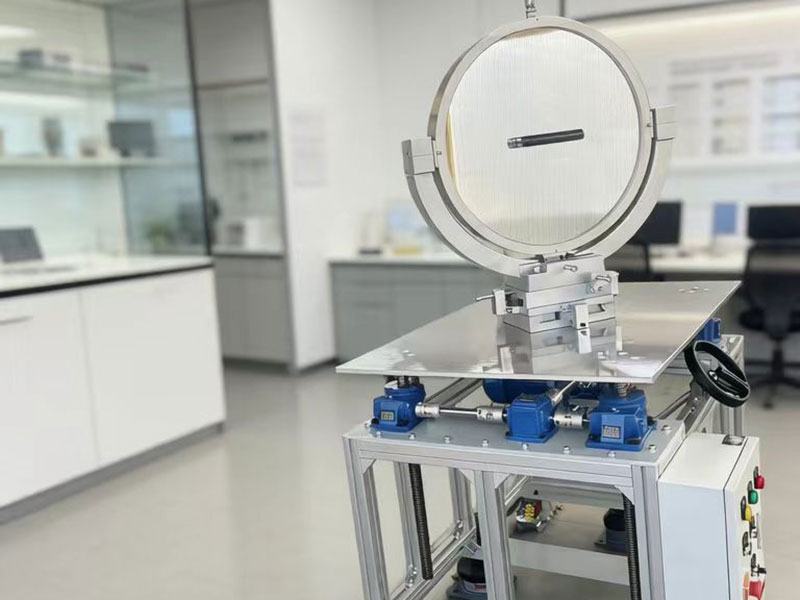
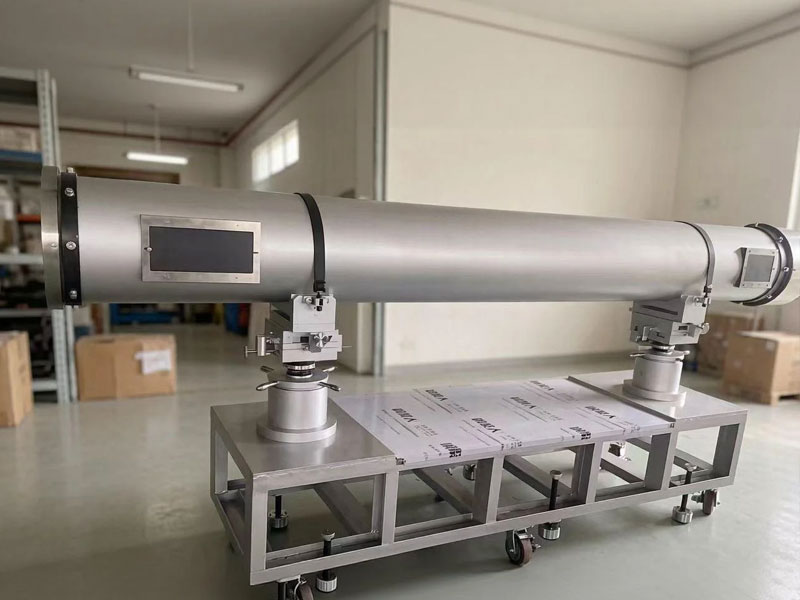
Non-intrusive flow visualization: Optical schlieren systems visualize density gradients in transparent media (air, gases) by detecting refractive index variations, without introducing tracer particles or physical probes into the flow field.
Adjustable sensitivity: Sensitivity can be tuned over a wide range by varying the knife-edge cutoff percentage. A cutoff of approximately 50% typically yields optimal schlieren image contrast.
Large field of view and flexible working distance: Focusing schlieren systems provide fields of view of 15–22 cm or larger, with working distances of 2–3.5 m, suitable for wind tunnel test sections. For larger areas (>1 m), projection focusing schlieren or background-oriented schlieren (BOS) can be employed.
Typical Specifications
System Architectures and Classifications
Z-type transmission schlieren: Classic Toepler schlieren system using two parabolic mirrors or lenses in a Z-shaped folded optical path, suitable for small-to-medium fields of view (≤30 cm).
Focusing schlieren: Uses a grid-patterned schlieren head and cutoff grid, imaging a specific focal plane without a collimated beam. Suitable for medium-to-large fields of view through wind tunnel windows (up to ~1 m).
Digital focusing schlieren: Uses an LCD/DLP projector to generate a source grid, combined with a retroreflective screen and digital camera. Achieves fields of view up to ~1 m with significantly improved automation and ease of use.
Background-oriented schlieren (BOS): Suitable for large-area (>1 m) or outdoor applications (e.g., airborne schlieren of aircraft), analyzing density fields from distortion of natural or artificial textured backgrounds. Lower sensitivity but highly scalable.
Core Optical Parameters
Field of view: Typically 15–22 cm (digital focusing schlieren); up to ≤30 cm (classic Z-type); up to ~1 m (focusing schlieren); meter-scale to outdoor scale (BOS).
Working distance: Typically 2.5-3.5 m (digital focusing schlieren); 2–3 m (analog focusing schlieren).
Frame rate: Up to 10 Mfps (digital systems, camera-dependent); up to 5 Mfps at full resolution or 10 MHz (analog systems).
Exposure time: As short as 10 ns (with pulsed laser sources such as Cavilux).
Light source: High-brightness LED (continuous or pulsed), pulsed laser diode (e.g., 640 nm Cavilux HF), mercury vapor lamp (traditional systems).
Cutoff elements: Knife-edge, color filter, grid cutoff, circular/oblique cutoff.
Optical aberrations: Z-type systems inherently exhibit astigmatism, which can be minimized by small offset angles and long focal length mirrors. Cylindrical lens correction can merge tangential and sagittal focal planes.
Representative Product Specifications
MetroLaser sTube (digital focusing schlieren): Working distance 2.5–3.5 m; field of view 15–22 cm; frame rate camera-dependent (up to 10 Mfps); exposure time 10 ns (with Cavilux); optical head weight 10.5 kg; light source weight 29.5 kg.
MetroLaser SchliereScope 10M (ultra-high-speed analog focusing schlieren): Working distance 2–3 m; field of view 15–22 cm; full-resolution 400 × 250 pixels; frame rate up to 10 MHz (5 Mfps at full resolution); exposure time 10 ns; pre-aligned, vibration-resistant design.
Main Applications
Aerodynamics and wind tunnel testing: Visualization of shock waves, boundary layer transition, vortices, and shock-wave/boundary-layer interactions (SWBLI) in high-speed flows, supporting both qualitative and quantitative density gradient analysis.
Combustion and flame research: Observation of density gradients, combustion instabilities, flame propagation, and temperature field distributions, aiding combustor optimization and numerical simulation validation.
Plasma diagnostics: Flow visualization of atmospheric-pressure plasma jets (APPJ), analysis of reactive species transport and jet structure. Narrow-band filters eliminate plasma self-emission interference.
Gas mixing and jet studies: Real-time visualization of helium/air jets and gas mixing processes for mass transfer research and burner design.
Shock wave and detonation physics: Ultra-high-speed schlieren systems capture shock wave propagation from spark discharges, explosion shock wave evolution, and other microsecond-to-nanosecond transient processes.
Material and glass inspection: Industrial inspection of refractive index homogeneity in CCD cover glass and optical glass, identifying micro-scale refractive index distributions invisible to the naked eye.
Airborne schlieren of aircraft: Solar/lunar limb schlieren techniques capture schlieren images of aircraft crossing the sun/moon limb from ground-based observations, used for aerodynamic performance assessment.
Education and laboratory demonstrations: Teaching schlieren systems demonstrate the optical visualization of refractive index changes in transparent media for physics and engineering laboratory courses.