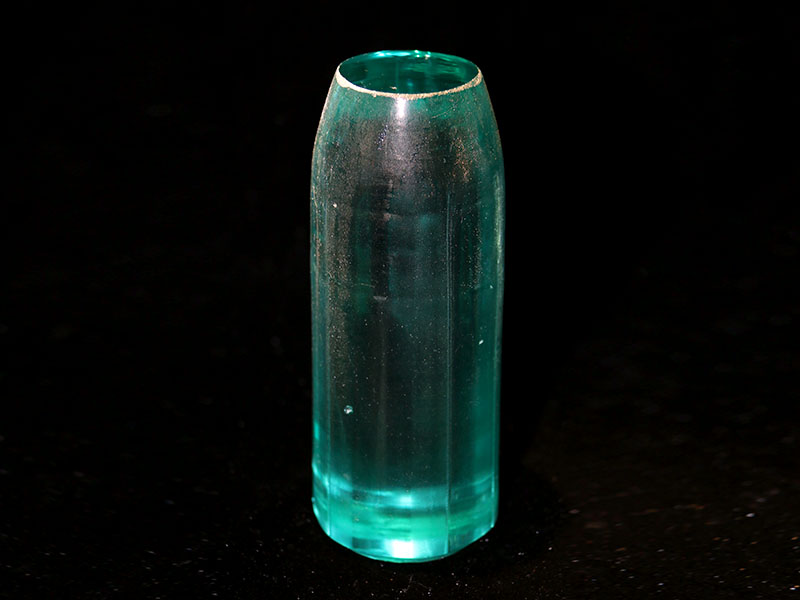
Yb:YAG (Ytterbium-Doped Yttrium Aluminum Garnet) Single Crystal
Description
Yb:YAG has a <10% quantum defect and low thermal load, the gain medium of choice for high-power thin-disk and ultrafast lasers.
Request Information
Technical details
Advantages
- Low quantum defect and reduced thermal load: The small energy difference between pump (940 nm) and laser (1030 nm) photons results in a quantum defect of less than 10%, reducing heat generation by a factor of 3-4 compared with Nd:YAG under equivalent pump power . This makes Yb:YAG the preferred gain medium for high-power and high-energy laser systems.
- Broad and simple electronic structure: Yb³⁺ possesses only two electronic manifolds (²F₅/₂ and ²F₇/₂), eliminating excited-state absorption (ESA), upconversion, and concentration quenching effects that limit other rare-earth-doped crystals . This enables high doping concentrations without degradation of laser performance.
- Wide absorption bandwidth: The 940 nm absorption band has a full width at half maximum of approximately 18 nm, eliminating the need for precise temperature control of pump laser diodes.
- Long upper-state lifetime: Fluorescence lifetime of approximately 1.0-1.3 ms, roughly four times longer than Nd:YAG, enabling efficient energy storage for Q-switched and pulsed laser operation.
- Broad emission bandwidth: Emission linewidth of approximately 9 nm supports ultrashort pulse generation, with sub-picosecond pulses achievable in mode-locked configurations.
- Excellent thermo-mechanical properties: High thermal conductivity (14 W/(m·K) at 20°C), high fracture strength, and Mohs hardness of 8.5 enable reliable operation under high thermal loads.
Typical Specifications
- Chemical formula: Yb³⁺:Y₃Al₅O₁₂
- Crystal structure: Cubic garnet, space group Ia3d
- Lattice constant: a = 12.01 Å
- Yb doping concentration: 0.5–30 at.% (standard commercial range: 1-10 at.%)
- Laser transition: ²F₅/₂ → ²F₇/₂
- Laser wavelength: 1030 nm (primary); tunable 1020–1060 nm
- Pump wavelength: 940 nm or 969 nm
- Pump absorption bandwidth: ~18 nm at 940 nm
- Absorption cross-section: 8.2 × 10⁻²¹ cm² @ 941 nm
- Emission cross-section: 2.1 × 10⁻²⁰ cm² @ 1030 nm
- Fluorescence lifetime: ~1.0–1.3 ms
- Emission linewidth: ~9 nm
- Refractive index: 1.82 @ 1030 nm
- Density: 4.56 g/cm³
- Melting point: 1970 °C
- Mohs hardness: 8.5
- Thermal conductivity: 14 W/(m·K) @ 20°C; 10.5 W/(m·K) @ 100°C
- Thermal expansion coefficient: 7.7–8.2 × 10⁻⁶/K (orientation-dependent)
- Thermo-optic coefficient: 7.3 × 10⁻⁶/K
- Damage threshold: ≥1 GW/cm² @ 1064 nm, 10 ns, 10 Hz
Standard Fabrication Specifications
- Orientation: <111>, <100>, or <110> ± 0.5°
- Diameter: 1–50 mm
- Length: 5–150 mm
- Dimension tolerance: Φ: +0/−0.1 mm; L: +0.5/−0 mm
- Perpendicularity: ≤5 arc min
- Parallelism: ≤10 arc sec
- Clear aperture: ≥95%
- Surface quality: 10/5 Scratch/Dig
- Surface flatness: ≤λ/10 @ 632.8 nm
- Wavefront distortion: ≤λ/8 per inch @ 632.8 nm
- AR coating: R < 0.15% @ 1030 nm
Main Applications
- High-power thin-disk lasers: Yb:YAG is the gain medium of choice for thin-disk laser systems, with CW output exceeding 1 kW demonstrated in dual-rod configurations . The low quantum defect and efficient thermal management make Yb:YAG ideal for industrial cutting, welding, and drilling applications.
- Picosecond and femtosecond pulse amplification: Yb:YAG is widely used in chirped-pulse amplification (CPA) systems for high-energy, high-repetition-rate picosecond lasers, particularly for industrial micromachining and scientific research.
- Q-switched microchip lasers: Compact Yb:YAG/Cr⁴⁺:YAG passively Q-switched microchip lasers have demonstrated 0.4 mJ pulses at 1030 nm with 350 ps pulse width and 1.1 MW peak power.
- Cryogenic high-energy lasers: At cryogenic temperatures (77 K), thermal conductivity increases by a factor of 9, saturation fluence decreases to 1.7 J/cm², enabling efficient energy extraction for high-energy laser fusion drivers.