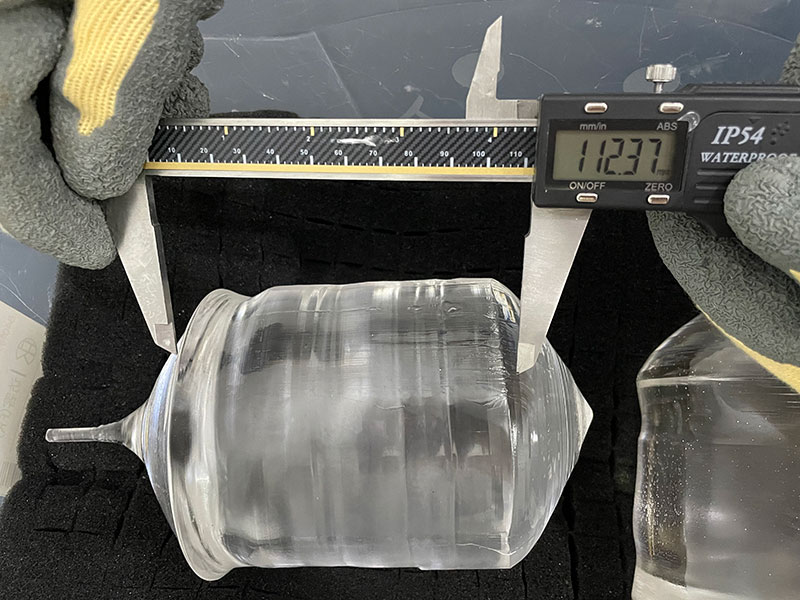
YCOB (YCa₄O(BO₃)₃, Yttrium Calcium Oxyborate) Laser-Grade Single Crystal
Description
YCOB grows to large apertures with a high damage threshold, the flagship crystal for petawatt-scale OPCPA and high-energy conversion.
Request Information
Technical details
Advantages
- Large-aperture growth capability: YCOB melts congruently and can be grown by the Czochralski method to diameters up to 150 mm, enabling clear apertures of 100 mm × 100 mm for high-energy laser systems.
- High laser damage threshold: Measured thresholds range from 0.8 GW/cm² to >1 TW/cm², depending on pulse width and wavelength; values exceeding 6 GW/cm² have been reported, higher than KTP, LBO, and β-BBO under comparable conditions .
- Excellent thermal stability: Small thermo-optic coefficients and large temperature acceptance bandwidth (490 °C·cm).
- Broad transparency range: Wide transmission from UV to near-IR, with low absorption in the terahertz region (<5 cm⁻¹ between 0.5–1.0 THz) .
- Non-hygroscopic and chemically stable: Insoluble in water, suitable for long-term operation without protective measures.
- Dual-function capability (Nd-doped): Can serve as both a laser gain medium and self-frequency-doubling crystal due to its non-centrosymmetric structure.
Typical Specifications
- Chemical formula: YCa₄O(BO₃)₃
- Crystal structure: Monoclinic, space group Cm (point group m); negative biaxial
- Lattice parameters: a = 8.076 Å, b = 16.020 Å, c = 3.531 Å, β = 101.17°
- Transparency range: 200–3000 nm
- Refractive indices (@1064 nm): nₓ ≈ 1.65, nᵧ ≈ 1.68, n_z ≈ 1.70 (negative biaxial, nₓ < nᵧ < n_z)
- Effective nonlinear coefficient (max): d_eff = 1.73 pm/V at (θ = 67°, φ = 143.5°)
- SHG conversion efficiency: 61.5% achieved with sub-ns Yb:YAG laser (1030 nm → 515 nm), potentially >70% with thicker crystal
- Laser damage threshold: 2.41 GW/cm² (X), 2.74 GW/cm² (Y), 2.65 GW/cm² (Z) @ 1064 nm; up to >1 TW/cm² for optimized conditions
- Thermal expansion: Low coefficient, suitable for high-average-power operation
Sellmeier equations (λ in μm) :
nₓ² = 2.7697 + 0.02034/(λ² − 0.01779) − 0.00643λ²
nᵧ² = 2.8741 + 0.02213/(λ² − 0.01871) − 0.01078λ²
n_z² = 2.9107 + 0.02232/(λ² − 0.01887) − 0.01256λ²
Main Applications
- The flagship application of YCOB. Petawatt-scale OPCPA has been demonstrated using YCOB crystals, achieving compressed pulses exceeding 1 PW peak power at the SG-II 5PW laser facility. Joule-level noncollinear OPCPA with 3.36 J output has also been achieved.
- High-energy second-harmonic generation (SHG): Frequency doubling of Yb:YAG and Nd:YAG lasers; 61.5% conversion efficiency has been demonstrated for 1030 nm sub-nanosecond pulses .
- High-average-power laser frequency conversion: Thermal properties and large aperture make YCOB suitable for high-repetition-rate systems requiring efficient heat dissipation.
- Self-frequency-doubling lasers (Nd:YCOB): Combined laser gain and nonlinear frequency conversion in a single crystal, enabling compact visible laser sources.