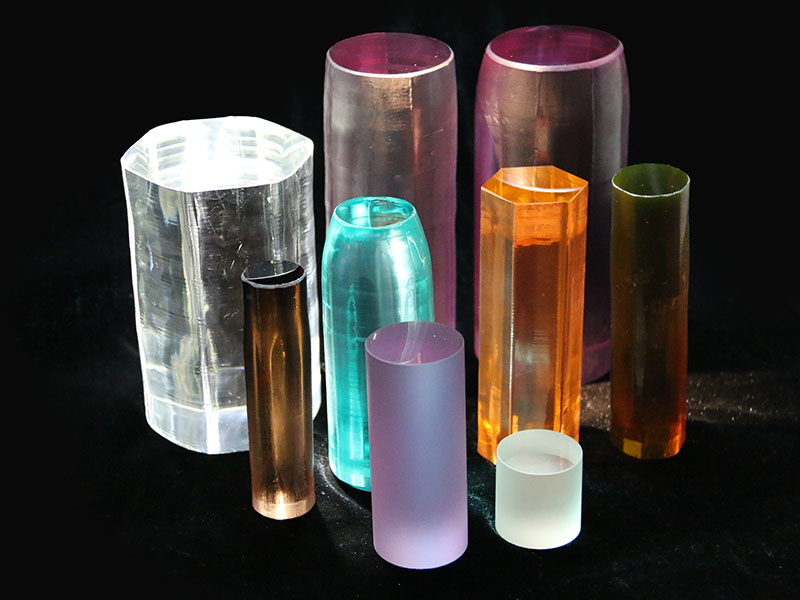
YAG (Y₃Al₅O₁₂, Yttrium Aluminum Garnet) Single Crystal
Description
Undoped YAG (Y₃Al₅O₁₂) transmits 210–5500 nm with excellent thermal stability, the key host for rare-earth-doped laser crystals.
Request Information
Technical details
Advantages
- Broad transparency range: 210–5500 nm, with particularly excellent transmission in the 4–5 μm region .
- No birefringence: YAG is optically isotropic (cubic structure), eliminating polarization-dependent effects and making it ideal for applications requiring low aberration.
- High thermal conductivity: 11–14 W/(m·K) at room temperature, approximately 10 times better than optical glasses, enabling efficient thermal management in high-power laser systems.
- Excellent mechanical properties: Mohs hardness of 8.5 and Knoop hardness of ~1215 kg/mm², providing outstanding durability and scratch resistance.
- High optical quality and chemical stability: Minimal absorption in the MWIR, excellent durability comparable to sapphire, and stable mechanical and chemical properties.
- Ideal host for rare-earth doping: Y³⁺ ions at dodecahedral sites can be substituted by Nd³⁺, Yb³⁺, Er³⁺, Ho³⁺, Tm³⁺, and other rare-earth ions, enabling a broad family of laser crystals.
Typical Specifications
- Chemical formula: Y₃Al₅O₁₂
- Crystal structure: Cubic garnet, space group Ia3d (Oₕ¹⁰)
- Lattice constant: a = 12.01 Å
- Transmission range: 210–5500 nm
- Refractive index: 1.8152–1.82 @ 1.064 μm
- Density: 4.55–4.56 g/cm³
- Mohs hardness: 8.5
- Knoop hardness: ~1215 kg/mm²
- Melting point: 1940–1970 °C
- Thermal conductivity: 11.2–14 W/(m·K) @ 20–25 °C
- Thermal expansion coefficient: 6.1–8.2 × 10⁻⁶/K (direction-dependent)
- Young‘s modulus: ~300 GPa
- Poisson’s ratio: 0.28
- Abbe number: 56
- Phonon energy: 800–860 cm⁻¹
- Band gap: ~6.5–8 eV
Main Applications
- Laser host crystals (rare-earth doped YAG): The most important application.
- Undoped YAG windows for high-energy laser systems, benefiting from high thermal conductivity and excellent MWIR transmission.
- White light generation: YAG windows produce broadband white light when pumped with ultrafast lasers, enabling femtosecond white light (continuum) generation.
- Optical substrates: YAG substrates for UV-IR optics requiring high thermal and mechanical stability .
- Laser endcaps: YAG crystals serve as ideal endcaps for doped YAG laser crystals, with diffusion bonding technology available.