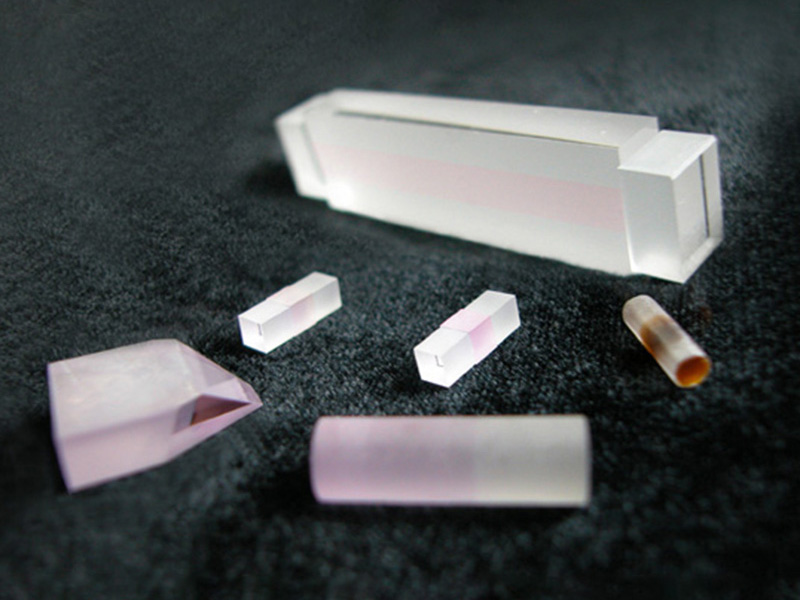
V:YAG (Vanadium-Doped Yttrium Aluminum Garnet) Single Crystal
Description
V:YAG acts as a saturable absorber at both 1.06 and 1.3 µm, an excellent passive Q-switch for 1300 nm Nd-doped lasers.
Request Information
Technical details
Advantages
- Dual-wavelength passive Q-switching capability: V:YAG functions as a saturable absorber at both 1064 nm and 1342 nm, making it uniquely suitable for synchronized dual-wavelength Q-switched lasers. This distinguishes it from Cr⁴⁺:YAG, which covers only 800–1200 nm and is unsuitable for the 1340 nm Nd³⁺ transition.
- Broad saturable absorption band: The tetrahedrally coordinated V³⁺ ion (V³⁺_tetra) exhibits a wide nonlinear saturable absorption band from 900 to 1600 nm, enabling Q-switching operation across the 1.0–1.5 μm spectral range.
- Long service life and high damage threshold: V:YAG offers long operational lifetime with a damage threshold exceeding 500 MW/cm², suitable for reliable passive Q-switch applications.
- Short recovery time: The excited-state recovery time is in the range of 5-22 × 10⁻²² s, enabling efficient pulse generation.
- Simple and compact configuration: As a passive Q-switch, V:YAG eliminates the need for high-voltage drivers and complex electro-optic components, reducing system size and cost.
Typical Specifications
- Chemical formula: V³⁺:Y₃Al₅O₁₂
- Crystal structure: Cubic garnet, space group Ia3d
- Orientation: <100> ± 0.5°
- Transmittance: 30%–97% (initial transmission, customizable)
- Optical density: 0.1–0.8
- Atomic transition structure: Two-level system
- Recovery time: 5-22 × 10⁻²² s
- Vanadium concentration: 0.05-0.35 wt%
- Ground-state absorption cross-section: 7.2 × 10⁻¹⁸ cm²
- Excited-state absorption cross-section: 7.4 × 10⁻¹⁹ cm²
- Emission/absorption bandwidth: 1000-1450 nm
- Center absorption wavelength: 1300 nm
- Absorption coefficient: 1.0-7.0 cm⁻¹
- Damage threshold: >500 MW/cm²
- Coating: Standard AR coating, R < 0.2% @ 1340 nm
Standard Fabrication Specifications
- Orientation tolerance: < 0.5°
- Surface flatness: < λ/8 @ 632 nm
- Wavefront distortion: < λ/4 @ 632 nm
- Surface quality: 10/5 Scratch/Dig
- Parallelism: 30 arc sec
- Perpendicularity: 15 arc min
- Clear aperture: > 90%
- Chamfer: < 0.2 mm × 45°
Main Applications
- Passive Q-switching of 1.3 μm Nd lasers: V:YAG is an excellent saturable absorber for the 1300 nm band, particularly for Nd:YAG, Nd:YAP, Nd:YVO₄, and Nd:KGW lasers operating at 1.3–1.34 μm.
- Dual-wavelength synchronized Q-switching: V:YAG enables simultaneous passive Q-switching at 1064 nm and 1342 nm in a single laser system, producing synchronized pulses at two widely separated wavelengths.
- Compact microchip lasers: V:YAG-based passively Q-switched Nd:YAG microchip lasers have demonstrated stable nanosecond pulses at 1.32 μm with pulse energies exceeding 0.1 mJ.
- Laser rangefinders and LIDAR: The compactness, stability, and long lifetime of V:YAG passive Q-switches make them suitable for laser ranging, remote sensing, and LIDAR systems.