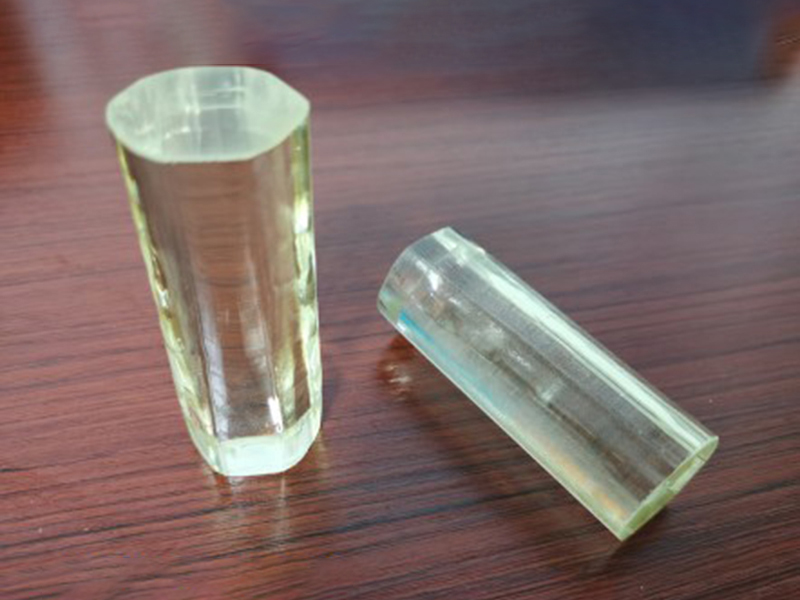
Tm:YLF (Thulium-Doped Yttrium Lithium Fluoride) Single Crystal
Description
Tm:YLF achieves near-unity quantum efficiency via cross-relaxation, the efficient 1.9 µm pump source for Ho:YAG and Ho:YLF lasers.
Request Information
Technical details
Advantages
- Two-for-one cross-relaxation for high quantum efficiency: At sufficient Tm³⁺ doping concentrations, the cross-relaxation process (³H₆ + ³H₄ → ³F₄ + ³F₄) enables quantum efficiency approaching 2, allowing efficient excitation with commercially available laser diodes at ~792 nm.
- Long upper-state lifetime for energy storage: The ³F₄ level lifetime is approximately 15–16 ms, enabling near-complete energy storage and reducing the number of pump diodes required for multi-joule pulse amplification compared with Yb:YAG.
- Naturally birefringent with polarized output: The anisotropic YLF host produces linearly polarized output along the a-axis, eliminating depolarization losses common in isotropic hosts.
- Negative thermo-optic coefficient for thermal distortion compensation: The negative dn/dT of YLF can partially offset thermal lensing and distortion, enabling high beam quality output even at high pump powers.
- Low nonlinear refractive index: n₂ = 0.6 × 10⁻¹³ esu, reducing nonlinear effects such as self-focusing in high-power operation .
- Broad wavelength tunability: Continuous-wave operation has been demonstrated with tuning from 1772 nm to 2145 nm, and multi-wavelength switching is achievable by adjusting output coupler transmittance.
Typical Specifications
- Chemical formula: Tm³⁺:LiYF₄
- Crystal structure: Tetragonal, space group I4₁/a
- Lattice constants: a = 5.16 Å, c = 10.85 Å
- Tm doping concentration: 0.5-5 at.% (customizable)
- Laser transition: ³F₄ → ³H₆
- Laser wavelength: π-polarization at 1880 nm; σ-polarization at 1908 nm
- Absorption peak wavelength: 792 nm
- Absorption bandwidth: ~16 nm
- Absorption cross-section: 0.55 × 10⁻²⁰ cm²
- Fluorescence lifetime (³F₄): ~15–16 ms at 300 K; ~18 ms at 78 K
- Emission cross-section: 2.4 × 10⁻²⁰ cm² (E//c at 100 K); 0.75 × 10⁻²⁰ cm² (E//a at 100 K)
- Refractive indices: nₒ = 1.448, nₑ = 1.470 @ 1064 nm
- Thermal conductivity: 6 W/(m·K)
- Thermo-optic coefficient (dn/dT): π = 4.3 × 10⁻⁶ K⁻¹; σ = 2.0 × 10⁻⁶ K⁻¹
- Thermal expansion coefficients: 10.1 × 10⁻⁶/K (∥c); 14.3 × 10⁻⁶/K (∥a)
- Melting point: 819 °C
- Density: 3.99 g/cm³
- Mohs hardness: 4-5
- Shear modulus: 85 GPa
- Specific heat: 0.79 J/(g·K)
Standard Fabrication Specifications
- Orientation: a-cut (for π-polarized output); [100] or [001] within 5°
- Rod sizes: Diameter 3–9.5 mm; Length 5-120 mm (rod or slab, customizable)
- Dimension tolerance: Diameter +0/−0.1 mm; Length ±0.5 mm
- Parallelism: ≤10 arc sec
- Perpendicularity: ≤5 arc min
- Surface flatness: ≤ λ/10 @ 632.8 nm
- Surface quality: 10/5 Scratch/Dig (MIL-O-13830A)
- Wavefront distortion: ≤ λ/4 per inch @ 632.8 nm
- Clear aperture: >95%
- Chamfer: 0.1 mm at 45°
- Damage threshold: 10-15 J/cm² @ 1900 nm, 10 ns
- AR coating: R < 0.25% @ 792 nm and 1.8–1.96 μm
Main Applications
- Pumping Ho:YAG and Ho:YLF lasers: The 1.9 μm Tm:YLF output coincides with the strong absorption peak of Ho³⁺, making it an ideal pump source for 2 μm holmium lasers.
- Mid-infrared OPO pumping: Tm:YLF lasers serve as pump sources for ZGP-based optical parametric oscillators generating 3–5 μm radiation.
- Medical laser systems: The 1.9 μm wavelength matches water absorption and is used for tissue cutting, coagulation, and urological procedures such as stone removal and tumor ablation.
- LIDAR and remote sensing: The 1.9 μm band falls within atmospheric transmission windows and overlaps with H₂O and CO₂ absorption lines, suitable for differential absorption LIDAR and laser detection.
- High-energy and high-peak-power lasers: Tm:YLF has achieved record performance including 45.85 W continuous-wave output with 80.9% slope efficiency and M² of 1.01 × 1.05 , and chirped-pulse amplification to >1 TW peak power with sub-300 fs pulses.
- Optical refrigeration: Tm:YLF is a promising material for mid-IR optical cryocoolers.
- Material processing and laser imaging: Suitable for applications requiring high average power and good beam quality in the 2 μm band.