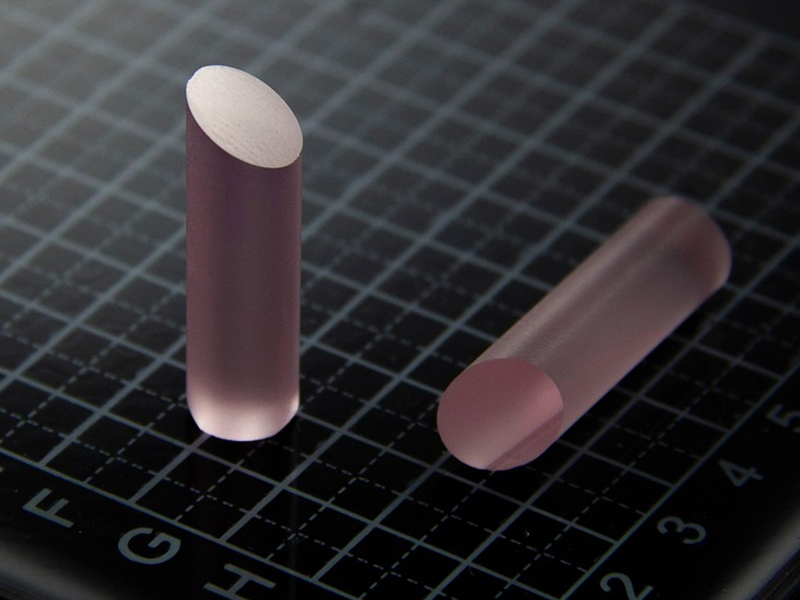
Ti³⁺:Al₂O₃ (Ti:Sapphire) Single Crystal
Description
Ti:sapphire tunes across 650–1100 nm with the broadest gain bandwidth, the foundation of femtosecond oscillators and amplifiers.
Request Information
Technical details
Advantages
- Broadest gain bandwidth supports laser tuning over 650–1100 nm and enables direct generation of pulses as short as 6.5 fs via Kerr-lens mode-locking .
- High thermal conductivity: 33 W/(m·K) at room temperature, about 3 times that of Nd:YAG, enabling high-average-power operation with manageable thermal effects .
- Excellent mechanical properties: Mohs hardness of 9, making it highly durable and resistant to damage .
- Strong Kerr nonlinearity: The Kerr-lens effect enables self-mode-locking without saturable absorbers, essential for femtosecond pulse generation .
- High damage threshold: Suitable for high-power amplifier systems and chirped-pulse amplification (CPA) architectures .
- Short upper-state lifetime: 3.2 μs, ideal for high-repetition-rate mode-locked oscillators .
Typical Specifications
- Crystal structure: Hexagonal (sapphire host); lattice constants a = 4.758 Å, c = 12.991 Å
- Ti₂O₃ concentration: 0.15, 0.25, 0.35, 0.45 wt% (other doping rate available upon request)
- Figure of Merit (FOM): > 150
- Tuning range: 650–1100 nm
- Emission peak: ~795 nm
- Absorption range: 400–600 nm; peak at 488–495 nm
- Fluorescence lifetime: 3.2 μs (T = 300 K)
- Peak stimulated emission cross-section: 4.1 × 10⁻¹⁹ cm² (∥c-axis);
- 2.0 × 10⁻¹⁹ cm² (⊥c-axis)
- Refractive index: 1.76 @ 800 nm
- Thermal conductivity: 33 W/(m·K)
- Density: 3.98 g/cm³
- Melting point: 2040 °C
- Mohs hardness: 9
- Standard Fabrication Specifications:
- Orientation: C-axis normal to rod axis
- End configurations: Flat/Flat or Brewster/Brewster
- Surface flatness: <λ/8 to λ/10 @ 633 nm
- Parallelism: <10–30 arc sec
- Surface quality: 10/5 Scratch/Dig
- Wavefront distortion: <λ/4 per inch
Main Applications
- The primary application is for Femtosecond mode-locked oscillators:, enabling sub-10-fs pulse generation for ultrafast spectroscopy, two-photon microscopy, and optical frequency combs.
- Chirped-pulse amplification (CPA) systems: Ti:sapphire serves as the gain medium in high-peak-power amplifier chains, including petawatt-class laser facilities .
- Widely tunable CW lasers: Replacement for dye lasers in spectroscopy, LIDAR, and medical laser systems .
- Deep UV generation: Frequency doubling in nonlinear crystals (e.g., BBO) produces UV/DUV output down to 193 nm for lithography and ultrafast UV applications .
- Widely used to pump OPO for extended wavelength coverage .
- High-repetition-rate amplifiers: Thermal management capabilities support kHz–MHz repetition rates at millijoule energy levels .