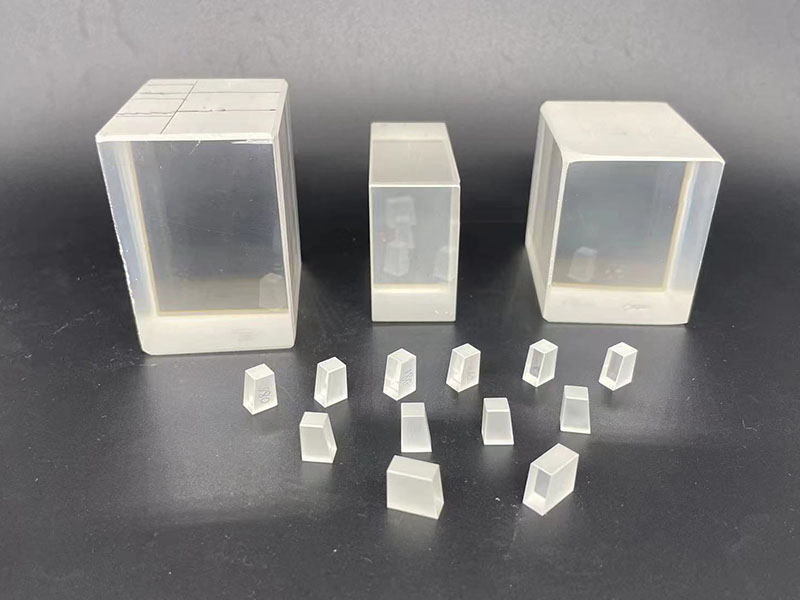
TeO₂ (Tellurium Dioxide) Single Crystal
Description
TeO₂ has an exceptional acousto-optic figure of merit (M₂ ≈ 1200), the leading crystal for AOMs, deflectors and laser Q-switching.
Request Information
Technical details
Advantages
- Exceptional acousto-optic figure of merit: M₂ = 1200 × 10⁻¹⁸ s³/g, approximately 1000 times higher than quartz.
- Extremely slow shear acoustic wave: The [110]-propagating slow shear mode has a velocity of only 616 m/s, just twice the speed of sound in air, enabling high-resolution acousto-optic device operation .
- High refractive index: nₒ ≈ 2.26, nₑ ≈ 2.14–2.24, contributing to strong acousto-optic interaction.
- Broad transparency range: 0.33–5.0 μm, covering visible to mid-infrared.
- High optical activity: 20–500°/mm, useful for polarization control.
- Well-established material for AO devices: Applied in >90% of modern acousto-optic instruments .
Typical Specifications
- Chemical formula: TeO₂ (α-phase, paratellurite)
- Crystal structure: Tetragonal, point group 422 (D₄); space group P4₁2₁2
- Lattice parameters: a = 4.810–4.812 Å, c = 7.613–7.616 Å
- Transparency range: 0.33–5.0 μm
- Refractive indices: nₒ = 2.260, nₑ = 2.142 @ 632.8 nm
- Transmittance: >70% @ 632.8 nm (uncoated)
- Acousto-optic figure of merit: M₂ = 1200 × 10⁻¹⁸ s³/g
- Acoustic velocity ([110] shear): 616 m/s
- Photoelastic coefficients: p₁₁ = 0.0074, p₁₂ = 0.187, p₁₃ = 0.340, p₃₁ = 0.0905, p₃₃ = 0.240, p₄₄ = −0.17, p₆₆ = −0.0463 @ 632.8 nm
- Density: 5.99–6.04 g/cm³
- Melting point: 730–733°C
- Mohs hardness: 3–4
- Thermal expansion coefficients: α₁₁ = α₂₂ = 17.7 × 10⁻⁶ K⁻¹; α₃₃ = 5.5 × 10⁻⁶ K⁻¹
- Elastic constants: c₁₁ = 5.57, c₃₃ = 10.58, c₄₄ = 2.65, c₆₆ = 6.59, c₁₂ = 5.12, c₁₃ = 2.18 (×10¹⁰ N/m²)
- Dielectric constants: ε₁₁ = 22.9, ε₃₃ = 24.7
Main Applications
- Acousto-optic modulators (AOM): Q-switching in solid-state lasers, cavity dumping, pulse picking, laser printing.
- Acousto-optic deflectors (AOD): Laser scanning, laser tweezers, RGB laser projection systems, laser scanning microscopy.
- Acousto-optic tunable filters (AOTF): Rapid-scan spectrometers, multispectral imaging, fiber-optic communication, spectropolarimeters.
- Laser Q-switches: Miniature AO Q-switches with demonstrated performance at 1064 nm (rise time ~29 ns, diffraction loss 35 ± 2%).
- RF spectrum analyzers: Signal processing and optical computing applications.
- Nonlinear optics (emerging): Third-order nonlinear susceptibility χ⁽³⁾ approximately 50 times higher than fused silica, promising for optical switching.