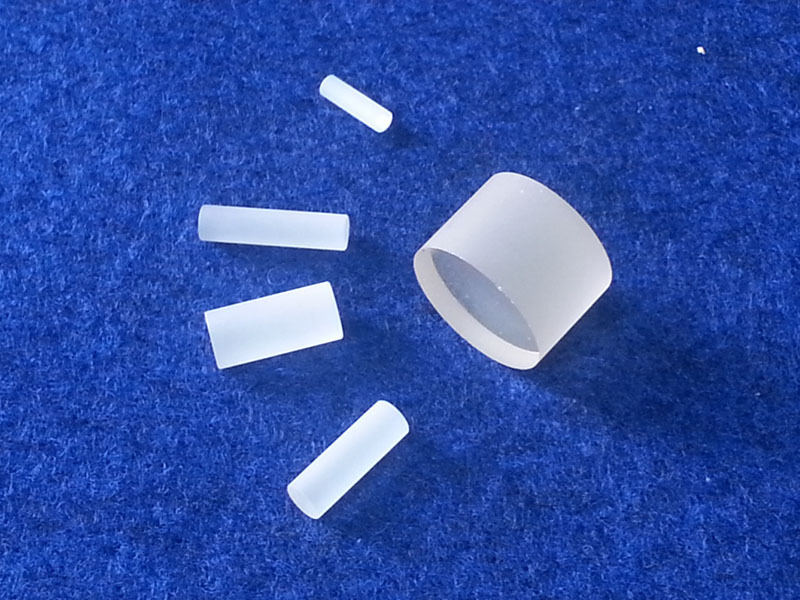
TGG (Tb₃Ga₅O₁₂, Terbium Gallium Garnet) Single Crystal
Description
TGG offers a Verdet constant ~2× that of terbium glass, the primary crystal for Faraday isolators protecting lasers from back-reflection.
Request Information
Technical details
Advantages
- High Verdet constant: ~35–40 rad/(T·m) at 1064 nm, approximately twice that of terbium-doped glass, enabling compact Faraday device designs.
- Excellent thermal properties: Thermal conductivity of 4.5–7.4 W/(m·K) at room temperature, one order of magnitude higher than terbium glass, making it suitable for high-average-power laser systems.
- High laser damage threshold: >1 GW/cm², allowing use in high-power laser applications.
- Low optical loss: <0.1%/cm at 1064 nm, ensuring high transmission efficiency.
- Well-established Czochralski growth: Large-diameter single crystals (up to ~100 mm) can be reliably produced.
- Broad operating wavelength range: 400–1100 nm (excluding 470–500 nm where absorption occurs).
Typical Specifications
- Crystal structure: Cubic garnet, space group Ia3d
- Lattice constant: a = 12.355 Å
- Orientation: <111> within ±15 arc min
- Density: 7.13 g/cm³
- Mohs hardness: 8.0
- Melting point: 1725 °C
- Refractive index: 1.954 at 1064 nm
- Verdet constant:
- ~35 rad/(T·m) at 1064 nm
- ~36.4 rad/(T·m) at 1064 nm (ceramic, reported)
- 134 rad/(T·m) at 632.8 nm
- 190–230 rad/(T·m) at 532 nm (room temperature)
- Thermal conductivity: 4.5–7.4 W/(m·K) at room temperature
- Transmission loss: <0.1%/cm
- Extinction ratio: >30 dB
- Laser damage threshold: >1 GW/cm²
- Wavefront distortion: <λ/8 at 633 nm
- Surface quality: 10/5 Scratch/Dig
- AR coating: R < 0.2% at 1064 ± 30 nm
Main Applications
- Faraday isolators: The primary application of TGG, used to prevent back-reflected light from destabilizing or damaging laser systems. TGG-based isolators are essential in high-power laser chains, fiber amplifiers, and oscillator configurations.
- Faraday rotators: 45° or 90° polarization rotators for laser systems requiring non-reciprocal polarization control.
- High-average-power laser systems: TGG ceramic and single crystal Faraday devices have been demonstrated for kW-class laser systems, with 53 mm diameter TGG ceramic rotators achieving compensated depolarization below 4% at incident laser power exceeding 900 W.
- Cryogenic laser systems: At liquid helium temperatures, the Verdet constant increases by up to 87 times relative to room temperature, enabling significant reduction in magnetic field requirements and device size for high-energy laser fusion drivers.
- Magnetic field sensing: TGG crystals are used as magneto-optic probes for time-resolved magnetic field measurements with sub-nanosecond resolution, capable of detecting mT-scale fields.