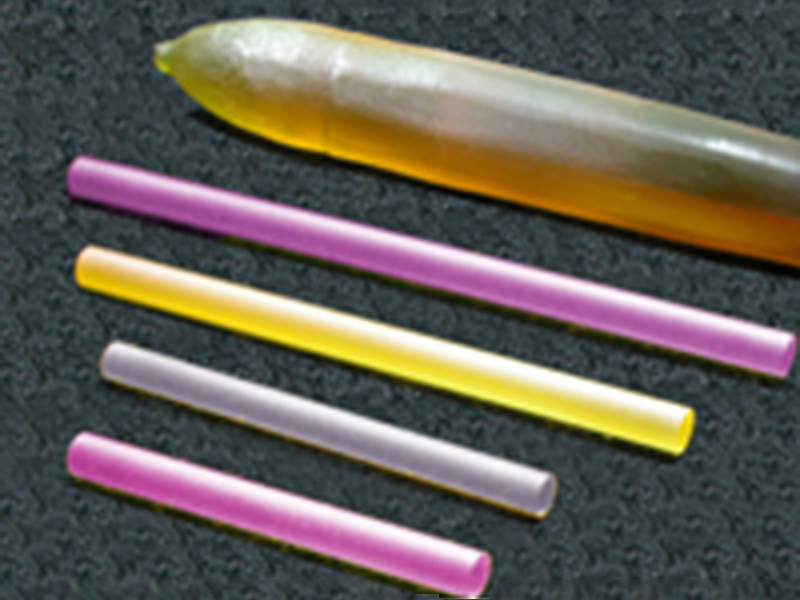
Sm:YAG (Samarium-Doped Yttrium Aluminum Garnet) Single Crystal
Description
Sm:YAG emits strongly at 618 nm and is a promising gain medium for directly diode-pumped orange-red visible solid-state lasers.
Request Information
Technical details
Advantages
- Orange-red visible laser potential: Sm:YAG exhibits strong emission at 618 nm corresponding to the ⁴G₅/₂ → ⁶H₇/₂ transition of Sm³⁺, making it a promising gain medium for red-orange wavelength laser applications.
- Excellent diode pump matching: The strongest visible absorption band is centered at 405 nm, which matches well with commercially available InGaN/GaN laser diodes, enabling efficient diode-pumped visible laser operation.
- Effective absorber at 1064 nm for ASE suppression: Sm:YAG exhibits strong absorption in the 1000-1400 nm region, with maximum absorption at 1067 nm. This makes it highly effective for suppressing amplified spontaneous emission (ASE) and parasitic oscillations in high-power Nd:YAG laser systems.
- High transparency in visible-NIR region: Sm:YAG is nearly completely transparent from 500 to 900 nm (and 80–900 nm in some measurements), ensuring minimal loss for visible laser operation.
- Long fluorescence lifetime: The ⁴G₅/₂ upper laser level has a measured fluorescence lifetime of 1.86 ms for Sm:YAG single crystal fibers, providing good energy storage capability.
Typical Specifications
- Chemical formula: Sm³⁺:Y₃Al₅O₁₂
- Crystal structure: Cubic garnet, space group Ia3d
- Lattice constant: a = 1.1993 nm
- Sm doping concentration: 3.0–10.0 at.%
- Laser transition: ⁴G₅/₂ → ⁶H₇/₂
- Primary emission wavelength: 618 nm
- Other emission lines: ~570 nm (⁴G₅/₂ → ⁶H₅/₂), ~650 nm (⁴G₅/₂ → ⁶H₉/₂)
- Pump wavelength: 405 nm (InGaN/GaN laser diode)
- Fluorescence lifetime (⁴G₅/₂): 1.86 ms
- Refractive index: ~1.82 (YAG host)
- Density: 4.56 g/cm³ (YAG host)
- Mohs hardness: 8.5
- Thermal conductivity: 14 W/(m·K) @ 20°C (YAG host)
- Melting point: 1970 °C
- Absorption at 1067 nm: Increases with Sm doping concentration; effective for ASE suppression
- Standard Fabrication Specifications
- Growth methods: Czochralski (CZ) method
- Orientation: <111> or <100>
- Surface quality: 10/5 Scratch/Dig
- Surface flatness: λ/8 @ 632.8 nm
- Parallelism: ≤30 arc sec
- Clear aperture: >90%
- AR coating: Customizable for visible wavelengths
Main Applications
- Sm:YAG is a promising gain medium for directly diode-pumped visible lasers operating in the 600–650 nm range, with potential applications in display, medical treatment, and spectroscopy.
- ASE suppression in high-power Nd:YAG lasers: Sm:YAG crystals are used as cladding or absorber elements to suppress amplified spontaneous emission and parasitic oscillations at 1064 nm, improving the performance of high-energy solid-state laser systems.
- High-pressure calibration: The ⁴G₅/₂ → ⁶H₇/₂ emission of Sm:YAG can be used for high-pressure calibration, with a pressure shift comparable to the ruby R₁ line but with much smaller temperature variations in line position.
- LED phosphors and white light sources: Sm³⁺-activated YAG nanocrystals exhibit bright orange-red emission under 405 nm excitation, suitable for near-UV LED and white light source applications.