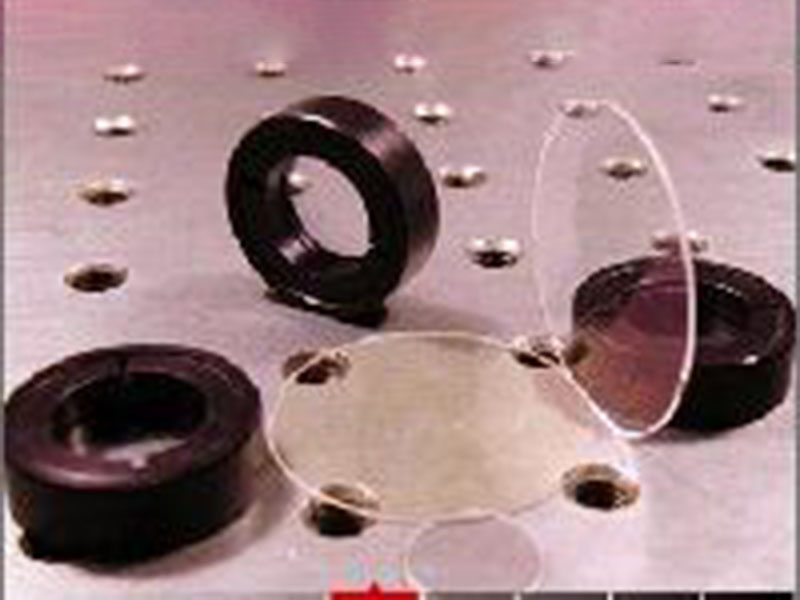
SiO₂ (Quartz) Optical-Grade Single Crystal
Description
Crystalline quartz (SiO₂) transmits 0.18–3.5 µm with excellent UV stability, standard for waveplates and precision polarization optics.
Request Information
Technical details
Advantages
- High transmittance from 0.18–3.5 μm, with >90% transmission in the visible range.
- High laser damage resistance: Withstands prolonged ArF excimer laser irradiation (193 nm) without degradation, maintaining high transmittance near the vacuum ultraviolet absorption edge.
- Radiation resistance: High-purity grades remain clear and maintain low energy absorption even after gamma-ray irradiation up to 31 MGy, suitable for space and nuclear environments.
- Optically isotropic (Z-cut): Z-cut quartz is non-birefringent at normal incidence, preserving beam polarization without altering light path.
- Insoluble in water and chemically stable: Excellent environmental durability, with low thermal expansion and high chemical resistance.
- Natural optical activity: Rotates plane-polarized light, enabling polarization control applications.
Typical Specifications
- Chemical formula: SiO₂
- Crystal structure: Trigonal, space group P3₁21 (right-handed) or P3₂21 (left-handed); α-quartz
- Phase transition temperature: 573 °C
- Transparency range: 0.18–3.5 μm (useful); extended transmission >50 μm in the terahertz region
- Refractive indices (@ 589 nm): nₒ = 1.5443, nₑ = 1.5534
- Birefringence (Δn): ~0.009
- Density: 2.635–2.660 g/cm³ @ 289 K
- Melting point: ~1740 K (1467 °C)
- Thermal conductivity: 10.7 W/(m·K) parallel; 6.2 W/(m·K) perpendicular @ 323 K
- Verdet constant (@ 635 nm): ~4.88 rad/(T·m)
- Solubility in water: None
- Available cuts: Z-cut, X-cut, Y-cut, AT-cut, and others
Main Applications
- Waveplates and polarization optics: Quarter-wave and half-wave plates for polarization control; Z-cut quartz preserves polarization while providing retardation.
- UV/VUV windows and prisms: Spectrometer prisms for UV measurement; optical components for ArF excimer laser systems (193 nm) and other deep-UV applications.
- Laser windows and substrates: High-damage-threshold windows for high-power laser systems; substrates for X-ray monochromators.
- Terahertz optics: Z-cut quartz windows for THz blackbody emission above 50 μm.
- Radiation-environment optics: Windows and components for space cameras, nuclear facilities, and satellite systems.
- Frequency control and timing devices: Piezoelectric substrates for SAW devices, crystal oscillators, and filters.