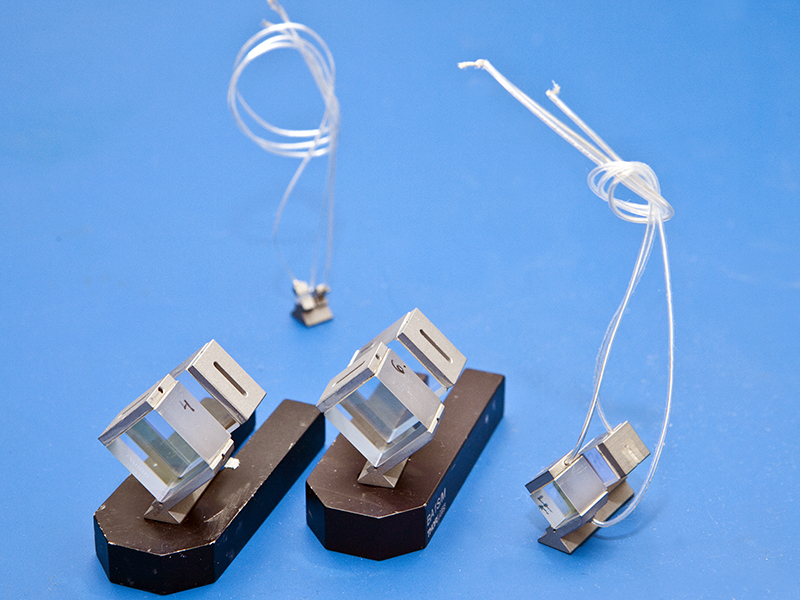
RTP (RbTiOPO₄, Rubidium Titanyl Phosphate) Single Crystal
Description
RTP (RbTiOPO₄) combines large electro-optic coefficients with no piezoelectric ringing, ideal for high-repetition E-O Q-switches.
Request Information
Technical details
Advantages
- Superior electro-optic performance: Large electro-optic coefficients (γ_c1 = γ_c2 = 30.2 pm/V) enable low half-wave voltage operation.
- RTP exhibits no induced piezoelectric ringing under electrical signals up to 60 kHz, making it ideal for high-repetition-rate electro-optic modulators and Q-switches .
- High damage threshold: Approximately 1.8 times that of KTP, enabling reliable operation in high-power laser systems .
- Extended IR transparency: Compared with KTP, RTP evades the strong idler absorption around 3 μm when pumped by Nd:YAG lasers, extending useful OPO operation further into the mid-infrared .
- High resistivity and low ionic conductivity: Optimized growth yields room-temperature dc resistivity of 10¹¹–10¹² Ω·cm, reducing leakage current for electro-optic device applications.
- Non-hygroscopic and chemically stable: Insoluble in water with excellent environmental durability.
Typical Specifications
- Crystal structure: Orthorhombic, space group Pna2₁; point group mm2; positive biaxial (nₓ < nᵧ < n_z)
- Lattice parameters: a = 12.96 Å, b = 10.56 Å, c = 6.49 Å
- Transparency range: 0.35–4.5 μm
- Refractive indices (@1064 nm): nₓ, nᵧ, n_z available via Sellmeier equations
- Effective nonlinear coefficient: d_eff = 2.04 pm/V (Type-II NCPM at 1030 nm)
- Electro-optic coefficients: γ_c1 = γ_c2 = 30.2 pm/V
- SHG conversion efficiency: Up to 65% (1064 nm → 532 nm)
- Damage threshold: 1.8 × KTP
- Curie temperature: 770–800°C (flux-dependent); exceeds 790°C for high-[Rb]/[P] fluxes
- Density: 3.6 g/cm³
- Mohs hardness: ~5
- Melting point: ~1000°C
- Thermal expansion coefficients: αₓ = 1.01 × 10⁻⁵/K, αᵧ = 1.37 × 10⁻⁵/K, α_z = −4.17 × 10⁻⁶/K
- Thermal optical coefficient: dλ/dT = −0.029 nm/°C
- Maximum aperture: up to 25 x 25 mm2
- Sellmeier equations (λ in μm) : nₓ² = 2.15559 + 0.93307/[1 − (0.20994/λ)²] − 0.01452λ² nᵧ² = 2.38494 + 0.73603/[1 − (0.23891/λ)²] − 0.01583λ² n_z² = 2.27723 + 1.11030/[1 − (0.23454/λ)²] − 0.01995λ²
Main Applications
- Electro-optic Q-switching and modulation: The primary application of RTP. Large electro-optic coefficients and absence of piezoelectric ringing make RTP the material of choice for high-repetition-rate Q-switches and electro-optic modulators.
- Second-harmonic generation (SHG): Frequency doubling of Nd:YAG (1064 nm) and Yb-doped lasers (1030 nm) with efficiency comparable to LBO; non-critical phase matching at room temperature for 1030 nm .
- Optical parametric oscillators (OPO): RTP-based OPOs pumped by Nd:YAG lasers avoid the idler absorption problem that limits KTP at ~3 μm, extending tunable mid-IR output .
- Optical parametric amplification (OPA): Suitable for high-energy and high-repetition-rate parametric amplification systems .