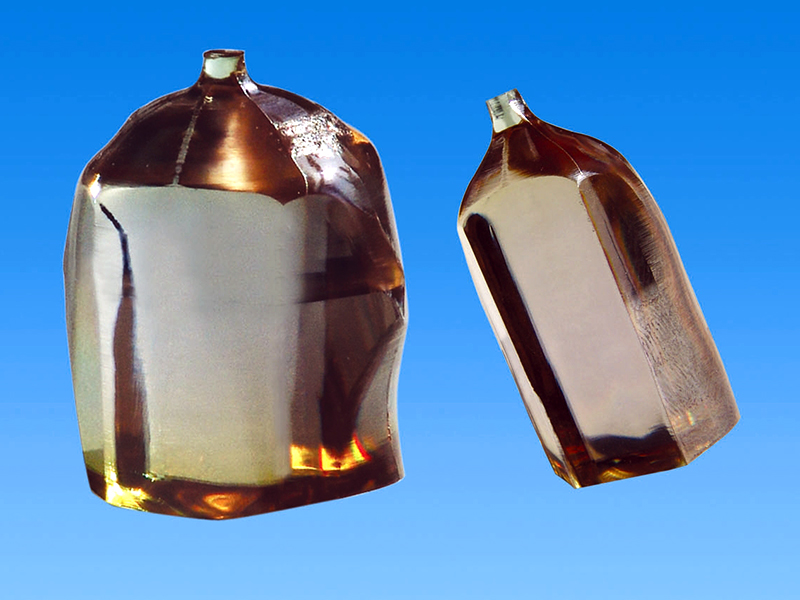
Nd:YVO₄ (Neodymium-Doped Yttrium Orthovanadate) Single Crystal
Description
Nd:YVO₄ provides 4–5× the emission cross-section of Nd:YAG, the preferred gain medium for compact CW and high-rep-rate DPSS lasers.
Request Information
Technical details
Advantages
- Exceptionally large stimulated emission cross-section: Approximately 4–5 times larger than Nd:YAG at 1064 nm, enabling high gain and low lasing threshold in diode-pumped configurations.
- Broad and strong absorption at 808 nm: The absorption bandwidth is approximately 3-5 times broader than Nd:YAG, significantly reducing the temperature-stabilization requirements for pump laser diodes and simplifying system design.
- Naturally birefringent with polarized output: The tetragonal YVO₄ host produces linearly polarized laser output along the π-direction without external polarizing elements, preventing multi-mode oscillation and enabling efficient frequency doubling.
- High Nd doping capability: The effective segregation coefficient of Nd in YVO₄ (~0.57-0.63) is much higher than in YAG (~0.18), allowing higher doping concentrations and stronger absorption in short crystal lengths.
- Excellent for compact and high-repetition-rate lasers: The combination of high gain, short upper-state lifetime (~90-120 μs), and natural birefringence makes Nd:YVO₄ the preferred gain medium for diode-pumped microchip lasers, high-repetition-rate Q-switched lasers, and self-Raman lasers.
Typical Specifications
- Chemical formula: Nd³⁺:YVO₄
- Crystal structure: Tetragonal, zircon-type, space group I4₁/amd (D₄ₕ¹⁹)
- Lattice parameters: a = b = 7.12 Å, c = 6.29 Å
- Nd doping concentration: 0.1–3.0 at.%
- Laser transition: ⁴F₃/₂ → ⁴I₁₁/₂
- Primary lasing wavelength: 1064 nm (also 1342 nm, 914 nm)
- Refractive indices (@1064 nm): nₒ = 1.9573, nₑ = 2.1652
- Absorption peak wavelength: 808 nm (also 880 nm, 888 nm)
- Absorption coefficient: ~35 cm⁻¹ @808 nm (1 at.% doping)
- Absorption cross-section: ~60 × 10⁻²⁴ m² @808 nm
- Stimulated emission cross-section: ~18 × 10⁻²⁰ cm² @1064 nm (π-polarization)
- Fluorescence lifetime: ~90-120 μs (doping-dependent)
- Gain bandwidth: ~1.7 nm (~280 GHz)
- Thermal conductivity: 5.1–5.2 W/(m·K)
- Thermal expansion coefficients: a-axis: ~2.5× smaller than c-axis
- Thermo-optic coefficient (dn/dT): ~8.5 × 10⁻⁶/K (c-axis), ~2.9 × 10⁻⁶/K (a-axis)
- Density: 4.22 g/cm³
- Mohs hardness: ~5
- Melting point: ~1650 °C
Standard Fabrication Specifications
- Orientation: a-cut (for π-polarized output along c-axis)
- Typical dimensions: 3 × 3 × (1-10) mm³; rods up to 40 mm length
- Dimension tolerance: ±0.1 mm
- Surface quality: 10/5 Scratch/Dig
- Surface flatness: λ/8 @ 633 nm
- Wavefront distortion: λ/4 @ 633 nm
- Parallelism: 20 arc sec
- Perpendicularity: 5 arc min
- Chamfer: 0.1 mm × 45°
- Coatings: AR/AR, HR/AR, or dichroic coatings available
Main Applications
- Nd:YVO₄ is the preferred gain medium for low- to medium-power continuous-wave and high-repetition-rate Q-switched lasers, offering high efficiency, low threshold, and compact size.
- High-repetition-rate Q-switched lasers: Passively Q-switched Nd:YVO₄ lasers using Cr⁴⁺:YAG or novel 2D saturable absorbers have achieved pulse widths in the nanosecond range with repetition rates up to 640 kHz.
- Self-Raman frequency conversion: Nd:YVO₄ simultaneously serves as the laser gain medium and Raman shift medium, enabling efficient generation of green (532 nm), lime (559 nm), and yellow (588 nm) wavelengths through intracavity stimulated Raman scattering and sum-frequency mixing.
- 1.3 μm lasers and frequency conversion: The 1342 nm transition enables deep-UV generation via harmonic generation (e.g., 193 nm for lithography seeding) and blue light generation through frequency tripling.
- Microchip and single-frequency lasers: Compact Nd:YVO₄ microchip lasers have achieved 760 mW single-frequency output at 1064 nm with birefringent filter tuning.
- Laser marking, printing, and ranging: Widely deployed in industrial and commercial systems requiring compact, efficient, and reliable laser sources.