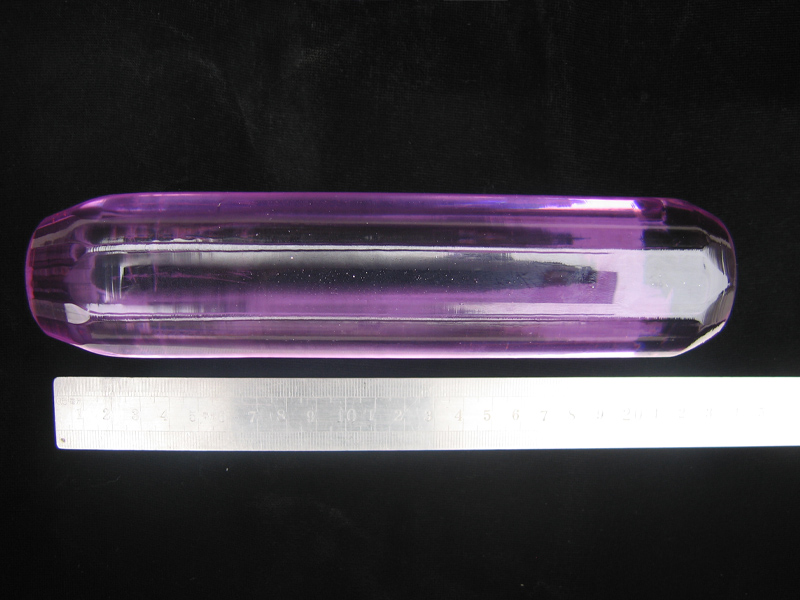
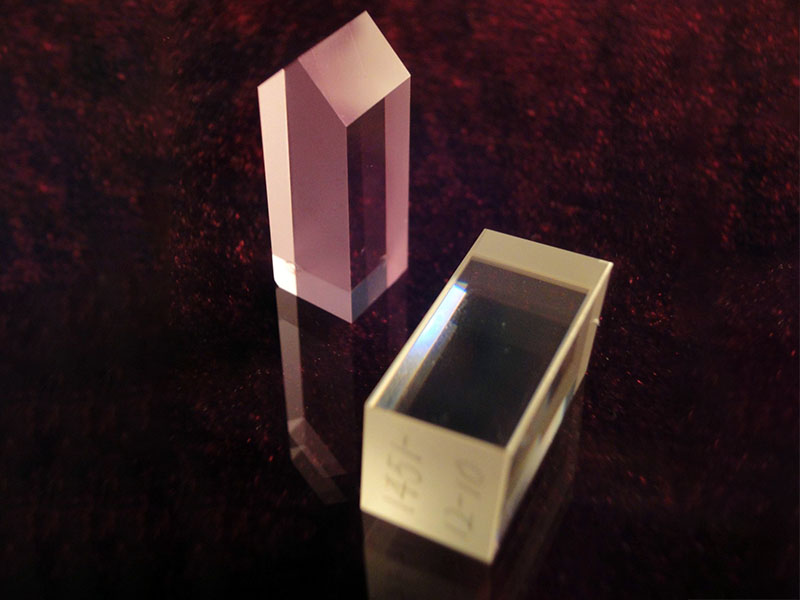
Most widely used solid-state laser material: Nd:YAG is the first and most famous laser crystal, serving as the foundational component for near-infrared solid-state lasers and their frequency multipliers.
Excellent thermal and mechanical properties: High thermal conductivity (~13–14 W/(m·K)), Mohs hardness of 8.5, and high thermal shock resistance enable reliable high-power operation.
Low lasing threshold and high gain: Relatively narrow gain bandwidth (~0.6 nm) allows high gain efficiency and low threshold operation.
Good spectral matching with laser diodes: Wide absorption band near 808 nm coincides with the emission of AlGaAs laser diodes, enabling efficient diode pumping.
High optical quality and large-diameter growth: Czochralski method enables production of large, core-free crystals with excellent optical homogeneity.
Diameter: 2–15 mm (standard); lengths up to 180 mm
Surface quality: 10/5 Scratch/Dig
Surface flatness: λ/8 @ 632.8 nm
Wavefront distortion: λ/10 @ 632 nm per inch
Parallelism: <10–20 arc sec
Perpendicularity: <5–15 arc min
Clear aperture: >90–95%
Chamfer: <0.2 mm × 45°
AR coating: R < 0.15–0.2% @ 1064 nm
Main Applications
High-power material processing: Nd:YAG lasers are extensively used for welding, drilling, cutting, trimming, and marking of metals, ceramics, and polymers.
Frequency-converted lasers: Second (532 nm), third (355 nm), and fourth (266 nm) harmonic generation for precision micromachining, lithography, and scientific research.
Medical laser systems: Used in surgical procedures, ophthalmology, dermatology, and therapeutic applications.
LIDAR and ranging: Q-switched Nd:YAG lasers provide high-peak-power pulses for remote sensing, laser rangefinders, and target designation.
Scientific research: Pump source for optical parametric oscillators (OPOs), Ti:sapphire amplifiers, and ultrafast laser systems.
Military and aerospace: Directed energy systems, countermeasures, and range finding applications.
Biophysics and analytical chemistry: Laser ablation ICP-MS, fluorescence spectroscopy, and photostimulation therapies.