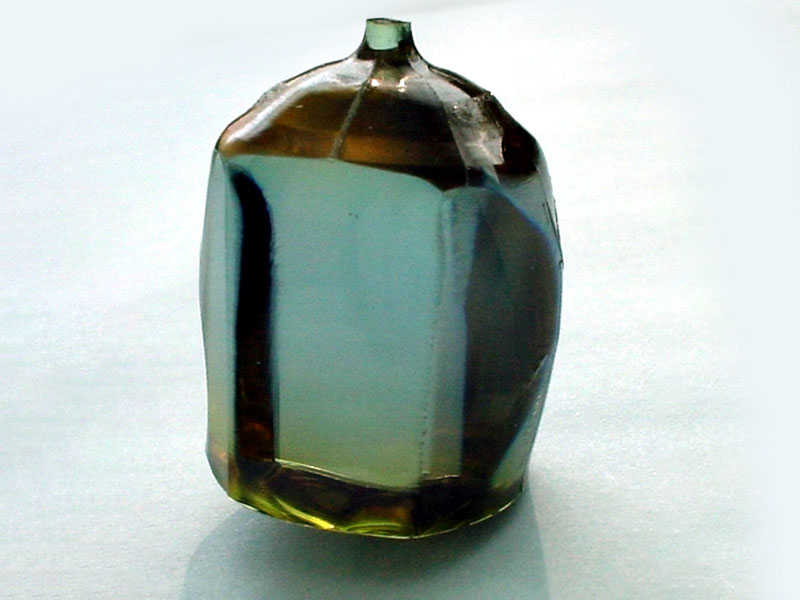
Nd:GdVO₄ (Neodymium-Doped Gadolinium Vanadate) Single Crystal
Description
Nd:GdVO₄ offers ~2× the thermal conductivity of Nd:YVO₄ and high gain, ideal for compact diode-pumped solid-state micro lasers.
Request Information
Technical details
Advantages
- Better thermal conductivity: 11.7 W/(m·K) along <110>, approximately twice that of Nd:YVO₄ and comparable to Nd:YAG, enabling high-power operation without severe thermal effects.
- Large stimulated emission cross-section: 7.6 × 10⁻¹⁹ cm² @ 1064 nm (π-polarization), providing high gain and low lasing threshold.
- High absorption coefficient: 74 cm⁻¹ at 808 nm (1.2% doping), with wide absorption bandwidth, reducing dependence on pump wavelength stability.
- Polarized laser output: Emission is naturally polarized parallel to the optical axis (c-axis), eliminating the need for external polarizing elements.
- Versatile lasing wavelengths: 1062.9 nm (⁴F₃/₂ → ⁴I₁₁/₂), 912.6 nm, and 1341.3 nm transitions available.
- High optical-to-optical efficiency: >60% demonstrated in diode-pumped configurations .
Typical Specifications
- Crystal structure: Tetragonal, space group I4₁/amd (D₄ₕ); zircon-type
- Lattice parameters: a = b = 7.21 Å, c = 6.35 Å
- Melting point: 1780°C
- Density: 5.47 g/cm³
- Mohs hardness: ~5
- Thermal conductivity: 11.7 W/(m·K) along <110>; 12.3 W/(m·K) along <001>
- Thermal expansion coefficient: αₐ = 1.5 × 10⁻⁶/K, αc = 7.3 × 10⁻⁶/K
- Refractive indices (@1064 nm): nₒ = 1.972, nₑ = 2.192
- Emission wavelength: 1062.9 nm (⁴F₃/₂ → ⁴I₁₁/₂)
- Emission bandwidth: 1.25 nm
- Stimulated emission cross-section: 7.6 × 10⁻¹⁹ cm² @1064 nm (π-polarization)
- Absorption cross-section: ~5.2 × 10⁻¹⁹ cm² @808 nm (π)
- Absorption coefficient: 74 cm⁻¹ @808 nm (1.2% Nd doping)
- Fluorescence lifetime: 90–100 μs (1.2 at.% Nd)
- Birefringence: Δn = 0.22007 @1064 nm
- Loss coefficient: 0.003 cm⁻¹ @1064 nm
- Thermo-optic coefficient: dn/dT = 4.7 × 10⁻⁶/K
- Nd doping range: 0.1%–3.0 at.% available
Sellmeier equations (λ in μm, pure GdVO₄) :
nₒ² = 3.8987165 + 0.05990622/(λ² − 0.0514395) − 0.011319λ²
nₑ² = 4.734369 + 0.1216149/(λ² − 0.0523664) − 0.013927λ²
Main Applications
- DPSS micro/mini lasers: Ideal gain medium for diode-pumped solid-state lasers requiring compact size and high efficiency.
- High-power picosecond regenerative amplifiers: Demonstrated 23 W average output at 100 kHz with M² ≈ 1.2 using a single bulk Nd:GdVO₄ crystal.
- Ranging, telemetering, and remote sensing: Used in LIDAR and remote sensing satellite systems due to polarized output and thermal stability.
- High-repetition-rate mode-locked lasers: Suitable for picosecond pulse generation owing to wide gain bandwidth and short upper-state lifetime.
- UV/green/IR laser systems: Intracavity frequency doubling and harmonic generation for 532 nm, 355 nm, and 266 nm output.
- Quasi-three-level 912 nm lasers: High-efficiency generation on the ⁴F₃/₂ → ⁴I₉/₂ transition, the shortest wavelength among Nd-doped crystals .