MgF₂ (Magnesium Fluoride) Ceramic
Description
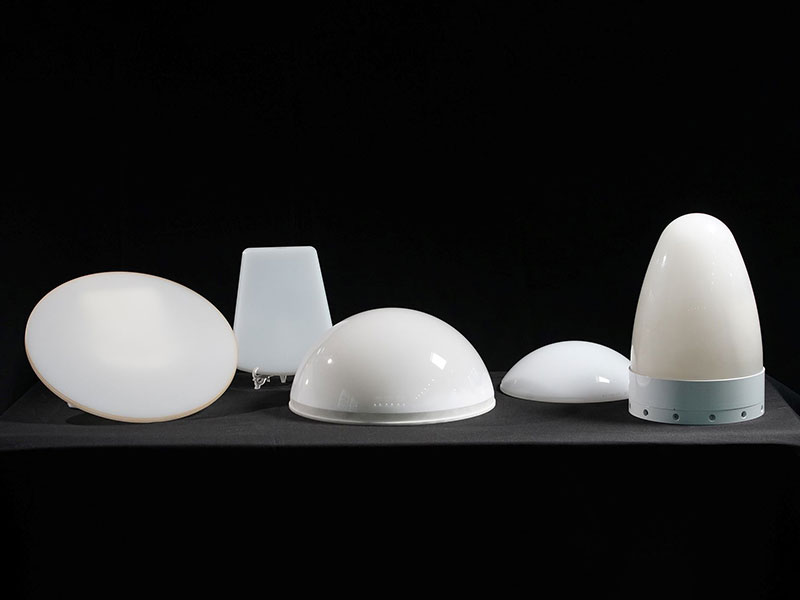
Hot-pressed MgF₂ ceramic transmits ~90% over 3–6.5 µm, the preferred material for rugged mid-infrared imaging and guidance domes.
Request Information
Technical details
Advantages
- High transmittance (>85%) across the 2–7.5 μm band, with ~90% transmittance in the 3–6.5 μm range (2–3 mm thickness).
- Superior mechanical strength: Knoop hardness >539 kg/mm², flexural strength >90 MPa, and compressive strength >300 MPa, making it suitable for harsh environments.
- Low preparation cost and scalable fabrication: Hot-pressed polycrystalline MgF₂ can be formed into large-size and complex shapes (domes, flat plates), overcoming the size limitations of single-crystal growth.
- Good thermal stability: Low thermal expansion coefficient (<1.3 × 10⁻⁵ K⁻¹ from 25–300°C) and stable transmission performance at elevated temperatures.
- Chemical stability: Insoluble in water and alcohol, chemically stable under normal conditions.
Typical Specifications
- Material: Hot-pressed polycrystalline MgF₂
- Transmission range: 0.7–9 μm
- Transmittance: >85% (2–7.5 μm); ~90% (3–6.5 μm)
- Refractive index: 1.3812 ± 0.005 @ 0.5893 μm
- Knoop hardness: >539 kg/mm²
- Vickers hardness: 6 GPa
- Flexural strength: >90 MPa (some sources: 130 MPa)
- Compressive strength: >300 MPa
- Fracture strength: 96 MPa
- Density: ≥3.17 g/cm³ (theoretical: 3.18 g/cm³)
- Thermal expansion coefficient: <1.3 × 10⁻⁵ K⁻¹ (25–300°C)
- Maximum use temperature: 600°C
- Available diameter: ~350 mm
- Thickness tolerance: ±0.2 mm (optional: ±0.1 mm, ±0.05 mm)
- Surface quality: 60/40 S/D
- Coating: Uncoated (high transmission requires no AR coating); coating available upon request
- 、
Main Applications
- Hot-pressed MgF₂ is the preferred material for mid-infrared (MWIR) imaging guidance domes, offering high IR transmittance, low thermal expansion, good mechanical properties, and low cost.
- Infrared windows: Used as MWIR windows for thermal imaging, aerospace, and defense optoelectronic systems.
- IR optical components: Lenses, prisms, and filters for infrared spectroscopy and thermal imaging systems.
- Protection windows: Windows for helicopters, land vehicles, and high-energy laser applications.