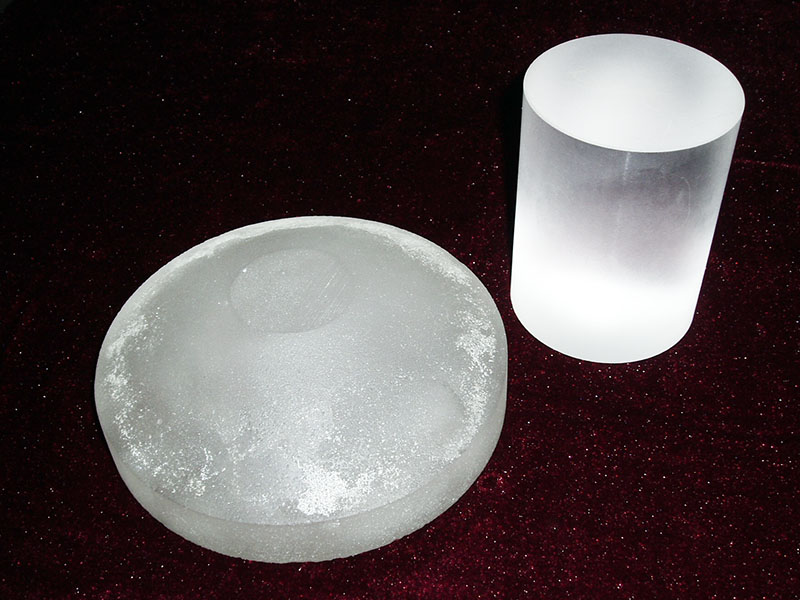
MgF₂ (Magnesium Fluoride) Single Crystal
Description
MgF₂ spans 110 nm to 8.5 µm with >80% transmission at 170 nm, standard for ArF/KrF excimer windows, lenses and prisms.
Request Information
Technical details
Advantages
- Transmission range extends from 110–120 nm to 7.5–8.5 μm, with >80% transmittance at 170 nm and ~60% at 121.6 nm without color-center formation .
- Higher bandgap than CaF₂: Bandgap of 11.8 eV (vs. 10.0 eV for CaF₂), providing superior resistance to ArF excimer laser radiation at 193 nm .
- Excellent deep-UV performance: Internal transmittance >99% at 193 nm; intrinsically low absorption and strong resistance to DUV radiation.
- Superior mechanical properties: Knoop hardness of 415 kg/mm², significantly harder than CaF₂, with good thermal shock resistance and mechanical strength .
- Low refractive index: n ≈ 1.38 at visible wavelengths, minimizing Fresnel reflection losses.
- Birefringent and polarizing capability: Positive uniaxial crystal (nₑ > nₒ); naturally birefringent, suitable for retardation plates and polarizing elements, particularly in the 0.13–0.30 μm range .
Typical Specifications
- Crystal structure: Tetragonal (rutile-type), space group P4₂/mnm (No.136); positive uniaxial
- Lattice parameters: a = b = 4.615 Å, c = 3.043 Å
- Transmission range: 0.11–8.5 μm
- Refractive indices (@ 0.7 μm): nₒ = 1.37608, nₑ = 1.38771
- Birefringence: Δn = 0.0115 @ 1.164
- Refractive index (@ 193 nm): nₒ = 1.43, nₑ = 1.45
- Bandgap: 11.8 eV
- Density: 3.18 g/cm³
- Melting point: 1255 °C
- Knoop hardness: 415 kg/mm²
- Thermal expansion coefficient: 13.7 × 10⁻⁶/°C (parallel to c-axis); 8.9 × 10⁻⁶/°C (perpendicular to c-axis)
- Thermal conductivity: 0.3 W/(m·K) @ 300 K
- Solubility in water: 0.0002 g/100g H₂O @ 0 °C
- Laser damage threshold: >60 J/cm² @ 248 nm, 14 ns.
Main Applications
- Excimer laser optics: Windows, lenses, and prisms for ArF (193 nm), KrF (248 nm), and other excimer laser systems.
- UV/DUV optical components: Windows, prisms, and lenses for vacuum ultraviolet and deep ultraviolet applications, including X-ray lithography and optical filters.
- Polarizing elements and waveplates: Birefringent plates, polarization rotators, and retardation plates for the 130–300 nm wavelength range.
- Infrared optical elements: Windows, dome and lenses for IR spectroscopy and thermal imaging (up to 7.5–8.5 μm).