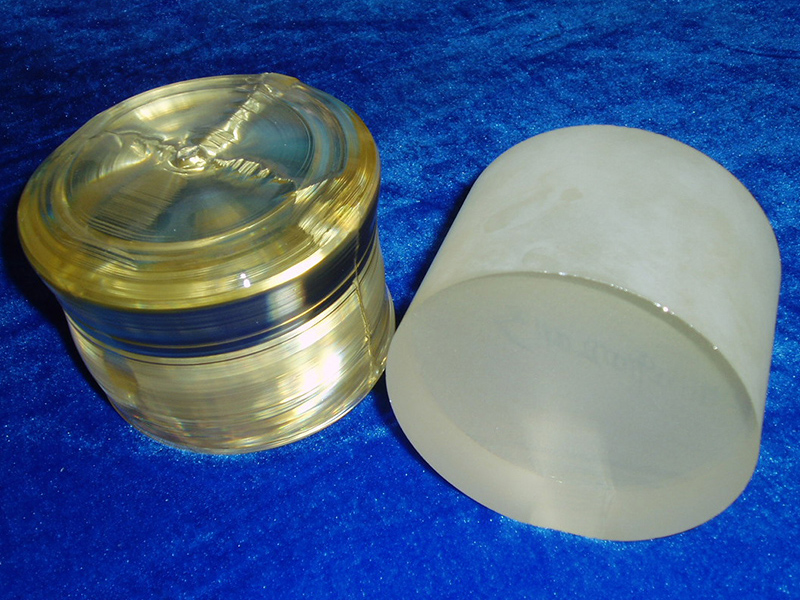
MgO:LiNbO₃ (Magnesium-Oxide-Doped Lithium Niobate) Single Crystal
Description
MgO:LiNbO₃ resists photorefractive damage and enables periodically poled QPM devices for high-efficiency frequency conversion.
Request Information
Technical details
Advantages
- MgO doping at the threshold concentration (~5 mol% for congruent LiNbO₃) increases the photorefractive damage threshold by approximately 100 times compared with undoped congruent LiNbO₃, enabling stable operation under high-intensity laser irradiation at room temperature without the need for elevated-temperature operation.
- Much lower coercive field: MgO-doped congruent LiNbO₃ exhibits a significantly reduced coercive field compared with undoped material, facilitating the fabrication of thick periodically poled structures for quasi-phase-matched (QPM) devices.
- Near-stoichiometric variant with superior performance: Near-stoichiometric LiNbO₃ doped with only 1–2 mol% MgO achieves even higher photorefractive damage resistance than 5 mol% MgO-doped congruent material, with no measurable photorefractive damage at 800 nm up to 10 MW/cm².
- Well-established threshold composition: Physical properties of MgO-doped LiNbO₃ (transition temperature, optical absorption edge, OH⁻ vibration frequency, density, etc.) exhibit a distinct threshold just above 5 mol% MgO concentration, providing a clear design guideline for optimized performance.
- Retains excellent intrinsic properties: MgO:LiNbO₃ maintains the large nonlinear optical coefficients (d₃₃ ≈ 25 pm/V), electro-optic coefficients, and broad transparency range of pure LiNbO₃, while eliminating its principal practical limitation.
Typical Specifications
- Chemical formula: MgO:LiNbO₃
- Crystal structure: Trigonal, space group R3c (ferroelectric phase); negative uniaxial
- Transparency range: 0.4–5.0 μm (with OH⁻ absorption at ~2.87 μm)
- Nonlinear coefficients (@1064 nm, 5 mol% MgO): d₃₁ = 4.4 pm/V, d₃₃ = 25 pm/V
- Effective nonlinear coefficient (PPMgLN): d_eff ≈ 14 pm/V (QPM configuration)
- SHG conversion efficiency: >65% for pulsed Nd:YAG; >45% for cw Nd:YAG
- NCPM temperature (1064→532 nm): 85–109°C for >5 mol% MgO (congruent LN); 25.4°C for 0.6 mol% MgO
- Coercive field: Significantly reduced compared with undoped LN (~1/4 of pure LN at room temperature)
- OH⁻ absorption peak: ~2828 nm (for heavily MgO-doped crystals)
- Density: ~4.64 g/cm³ (typical for congruent LiNbO₃)
Sellmeier equations (5 mol% MgO, λ in μm) :
nₒ² = 4.8762 + 0.11554/(λ² − 0.04674) − 0.033119λ²
nₑ² = 4.5469 + 0.094779/(λ² − 0.04439) − 0.026721λ²
Main Applications
- Periodically poled QPM devices, enabling high-efficiency frequency conversion from visible to mid-IR (5 nm to 300 μm). Large-aperture PPMgLN OPOs have achieved 110 mJ output with 75% slope efficiency and tuning from 4.6 to 11.2 μm.
- High-power SHG of Nd:YAG lasers: Noncritical phase matching (NCPM) at room temperature; single-pass conversion of 53% from 1.064 μm to 0.532 μm at 50 MW/cm² has been demonstrated.
- Optical parametric oscillators and amplifiers (OPO/OPA/OPCPA): Widely tunable mid-IR sources; PPMgLN-based OPOs have achieved 44% optical-optical conversion efficiency with tuning from 1.42–1.73 μm (signal) and 2.76–4.27 μm (idler).
- Electro-optic modulators and Q-switches: Large electro-optic coefficients make MgO:LiNbO₃ suitable for Pockels cells, Q-switches, and phase modulators.
- Waveguide devices: Periodically poled MgO:LiNbO₃ ridge waveguides for green laser generation via QPM-SHG.
- Terahertz wave generation: Micro-domain-engineered PPMgLN enables THz generation through optical rectification and difference-frequency generation.