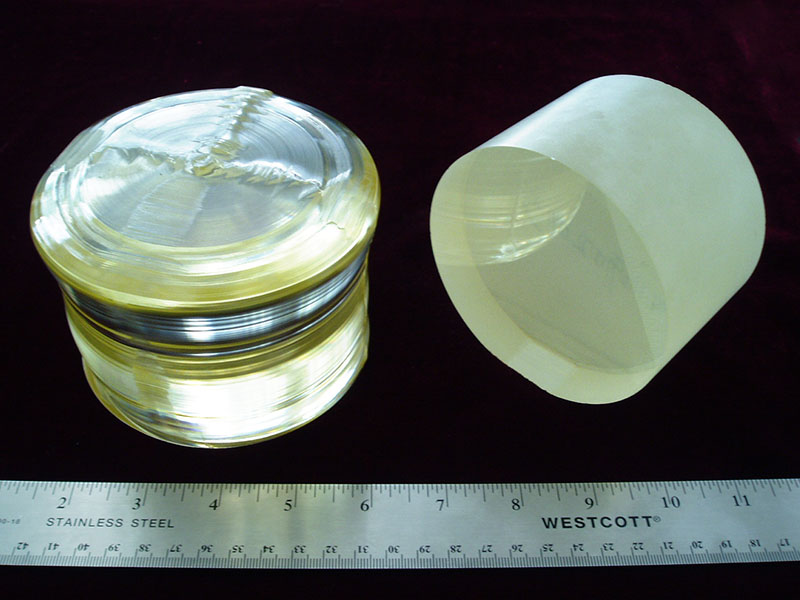
LiNbO₃ (Lithium Niobate) Laser-Grade Single Crystal
Description
LiNbO₃ features large electro-optic coefficients (r₃₃ ≈ 31 pm/V), standard for E-O Q-switches, modulators and waveguide devices.
Request Information
Technical details
Advantages
- Large electro-optic coefficients (r₃₃ = 30.8–32 pm/V at low frequency, r₁₃ = 8.6–10 pm/V) enabling efficient Q-switching, phase modulation and Pockels cell operation in Nd:YAG, Nd:YLF, and Ti:sapphire laser systems .
- Transparency range: 420–5200 nm, with low absorption loss (~0.1%/cm at 1064 nm).
- High nonlinear optical coefficient: d₃₃ = 34.4 pm/V, making LiNbO₃ suitable for frequency doubling above 1 μm, optical parametric oscillation (OPO) pumped at 1064 nm, and difference-frequency generation.
- Non-hygroscopic and mechanically stable: Insoluble in water, with good thermal stability and high Curie temperature (1140 ± 5 °C), ensuring long-term device reliability.
- Large crystal growth capability: Can be grown into large, high-quality crystals by the Czochralski (CZ) method, enabling cost-effective production of optical components and waveguide substrates.
Typical Specifications
- Crystal structure: Trigonal, space group R3c; point group 3m; negative uniaxial
- Lattice parameters: a = 0.515 nm, c = 13.863 nm, Z = 6
- Transparency range: 420–5200 nm
- Refractive indices:
- @ 1064 nm: nₑ = 2.156, nₒ = 2.232
- @ 1300 nm: nₑ = 2.146, nₒ = 2.220
- @ 632.8 nm: nₑ = 2.203, nₒ = 2.286
- Nonlinear coefficients: d₃₃ = 34.4 pm/V, d₃₁ = d₁₃ = 5.95 pm/V, d₂₂ = 3.07 pm/V
- Electro-optic coefficients (low frequency): r₃₃ = 32 pm/V, r₃₁ = 10 pm/V, r₂₂ = 6.8 pm/V
- Electro-optic coefficients (high frequency): r₃₃ = 31 pm/V, r₃₁ = 8.6 pm/V, r₂₂ = 3.4 pm/V
- Absorption coefficient: ~0.1%/cm @ 1064 nm
- Melting point: 1255 ± 5 °C
- Curie temperature: 1140 ± 5 °C
- Mohs hardness: 5
- Density: 4.64 g/cm³
- Thermal conductivity: 38 W/(m·K) @ 25 °C
- Thermal expansion coefficients: ∥a: 2.0 × 10⁻⁶/K; ∥c: 2.2 × 10⁻⁶/K
Sellmeier equations (λ in μm) :
nₒ² = 4.9048 + 0.11768/(λ² − 0.04750) − 0.027169λ²
nₑ² = 4.5820 + 0.099169/(λ² − 0.04443) − 0.021950λ²
Standard Fabrication Specifications (Laser-Grade)
- Typical Q-switch size: 9 × 9 × 25 mm³ or 4 × 4 × 15 mm³
- Orientation tolerance: Z-axis: ±5 arc min; X/Y-axis: ±10 arc min
- Dimension tolerance: ±0.1 mm (X/Y-axis); ±0.2 mm (Z-axis)
- Surface quality: 10/5 Scratch/Dig
- Surface flatness: λ/8 @ 633 nm
- Wavefront distortion: <λ/4 @ 633 nm
- Parallelism: <20 arc sec
- Perpendicularity: <5 arc min
- AR coating: R < 0.2% @ 1064 nm
Main Applications
- The primary laser application of LiNbO₃, used in Nd:YAG, Nd:YLF and Ti:sapphire laser systems for Q-switching and pulse generation.
- Electro-optic modulators and phase modulators: Widely used in fiber-optic communication systems, including Mach-Zehnder intensity modulators and phase modulators.
- Second-harmonic generation (SHG): Frequency doubling for wavelengths >1 μm, particularly effective for low-power laser diodes in the 1.3–1.55 μm range.
- Optical parametric oscillators (OPO) and amplifiers (OPA): Pumped at 1064 nm for tunable infrared generation .
- Difference-frequency mixing (DFM): Generation of tunable mid-infrared wavelengths (e.g., 1.2–1.8 μm and 1.37–1.77 μm ranges) for spectroscopy applications .
- Waveguide substrates and SAW devices: LiNbO₃ substrates for integrated optical waveguides and surface acoustic wave (SAW) wafers .
- Quasi-phase-matched (QPM) devices: Periodically poled lithium niobate (PPLN) for efficient frequency conversion.