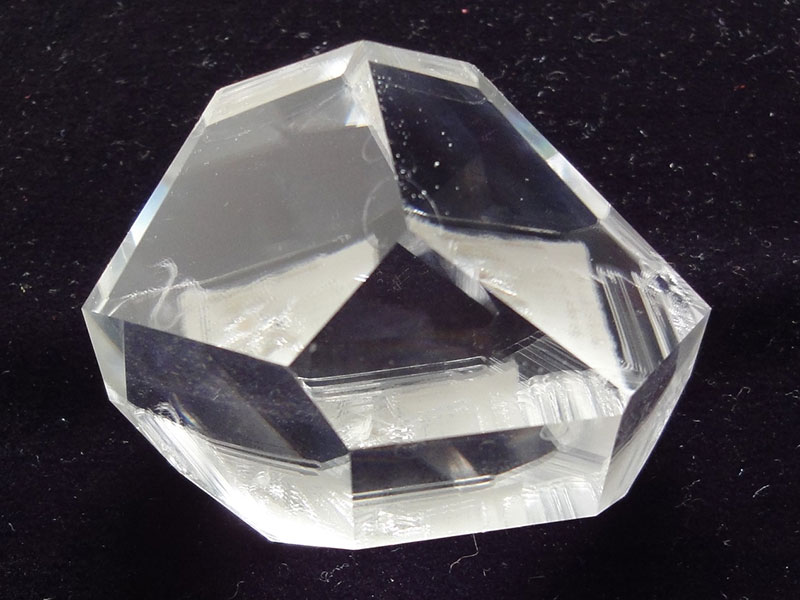
LiB₃O₅ (LBO, Lithium Triborate) Single Crystal
Description
LBO (LiB₃O₅) withstands 45 GW/cm² and delivers high-power 532 nm and 355 nm harmonic generation for demanding industrial lasers.
Request Information
Technical details
Advantages
- Extremely high optical damage threshold: 45 GW/cm² for 1.1 ns pulses at 1064 nm, which is 3.57 times higher than KDP and 1.6 times higher than BBO. This makes LBO a common choice for high-power and high-energy laser systems.
- Transparency range: 160–2600 nm, LBO is transparent with very low absorption from 0.16 to 1.6 μm .
- SHG conversion efficiency of 65% (surface reflection corrected) has been demonstrated with a single crystal . Conversion efficiency is approximately three times that of KDP .
- Wide acceptance angle and small walk-off: LBO exhibits a much larger angular tuning half-width compared with KDP, enabling efficient harmonic conversion even in laser systems with large beam divergence or tight focusing .
- Non-hygroscopic and chemically stable: LBO crystals showed no surface change after immersion in water at room temperature for one month, demonstrating excellent environmental stability without protective coatings.
- Good mechanical properties: Mohs hardness of 6, significantly harder than KDP (2.5) and BBO (4.5), with strong resistance to thermal shock.
- Noncritical phase matching (NCPM): Achievable near 1300 nm, allowing temperature-tuned phase matching without angular adjustment.
Typical Specifications
- Crystal structure: Orthorhombic, space group Pna2₁, point group mm2; biaxial
- Lattice parameters: a = 8.4473 Å, b = 7.3788 Å, c = 5.1395 Å
- Transparency range: 160–2600 nm
- SHG phase-matching range: 551–2600 nm (Type I); 790–2150 nm (Type II)
- Nonlinear coefficients: d₃₁ = 1.05 ± 0.09 pm/V; d₃₂ = −0.98 ± 0.09 pm/V; d₃₃ = 0.05 ± 0.006 pm/V
- Laser damage threshold: 45 GW/cm² @ 1064 nm, 1.1 ns; 11.2 GW/cm² @ 1064 nm, 25 ns. AR coated: 1 GW/cm² @ 1064 nm, 10 ns, 10 Hz .
- Mohs hardness: 6
- Density: 2.47 g/cm³
- Melting point: ~834°C
- Thermal conductivity: 3.5 W/(m·K)
- Thermal expansion coefficients: αₓ = 10.8 × 10⁻⁵/K; αᵧ = −8.8 × 10⁻⁵/K; α_z = 3.4 × 10⁻⁵/K
- Thermo-optic coefficients (10⁻⁶/K): dnₓ/dT = −9.3; dnᵧ/dT = −13.6; dn_z/dT = (−6.3 − 2.1λ)
- Absorption coefficient: <0.1%/cm @ 1064 nm; <0.3%/cm @ 532 nm
- Acceptance angle: 52 mrad·cm
Sellmeier equations (λ in μm) :
nₓ² = 2.454140 + 0.011249/(λ² − 0.011350) − 0.014591λ² − 6.60 × 10⁻⁵λ⁴
nᵧ² = 2.539070 + 0.012711/(λ² − 0.012523) − 0.018540λ² + 2.0 × 10⁻⁴λ⁴
n_z² = 2.586179 + 0.013099/(λ² − 0.011893) − 0.017...
Main Applications
- High-power harmonic generation: Second (532 nm) and third (355 nm) harmonic generation of Nd:YAG, Nd:YLF, and Ti:sapphire lasers . LBO is the preferred crystal for medium- to high-power 1064 nm frequency conversion.
- High-energy laser fusion systems: Large-aperture frequency conversion devices; 100 × 100 mm² SHG devices is available.
- Optical parametric oscillators and amplifiers (OPO/OPA): Tunable output pumped at 308, 355, 532, and 1064 nm; widely used in picosecond and femtosecond laser systems .
- Deep UV generation: Sum-frequency generation (SFG) for producing output below 200 nm (down to ~185 nm) from incident laser wavelengths in the 0.375–3.0 μm range .
- Terahertz wave generation: Recent research has extended LBO application to the THz range via difference-frequency generation and down-conversion from near-infrared, with measured birefringence of Δn = 0.42 in the THz region .
- Autocorrelators for ultrafast lasers: Thin LBO crystals used in autocorrelators for picosecond and femtosecond pulse characterization .