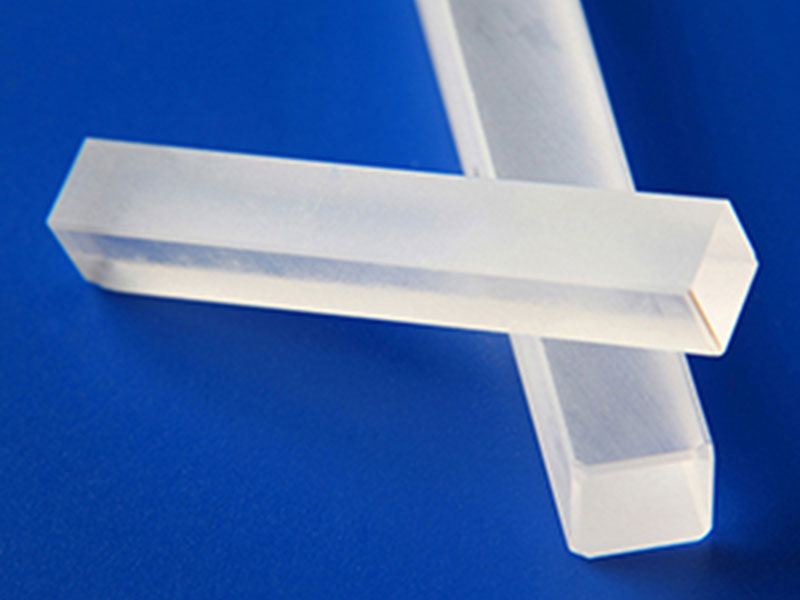
KYW (KY(WO₄)₂, Potassium Yttrium Tungstate) Single Crystal
Description
KYW (KY(WO₄)₂) provides large Raman shifts of 765 and 905 cm⁻¹, a primary choice for Raman shifting and ultrafast conversion.
Request Information
Technical details
Advantages
- Transparency range: 0.35–5.5 μm, with high optical quality.
- Two intense Raman shifts: 905 cm⁻¹ (E∥Nₘ) and 765 cm⁻¹ (E∥N_g), polarization-dependent, making KYW an excellent stimulated Raman scattering (SRS) crystal for frequency conversion.
- Excellent acousto-optic performance: Acousto-optic figure of merit M₂ = 15 × 10⁻¹⁵ s³/kg (along N_g–30°), approximately 7 times that of quartz, with damage threshold up to 2 GW/cm² at 1064 nm (10 ns) .
- High radiation resistance and thermal stability: Superior to quartz and paratellurite for high-power laser modulation in the 1–3 μm range.
- Versatile rare-earth doping host: Y³⁺ sites can be substituted by Yb³⁺, Tm³⁺, Er³⁺, Ho³⁺, and other rare-earth ions, enabling a wide range of laser applications .
- Good mechanical properties: Mohs hardness of 4–5, suitable for high-power operation .
Typical Specifications
- Crystal structure: Monoclinic, space group C2/c (α-phase, low-temperature form); point group 2/m
- Lattice parameters: a = 8.05 Å, b = 10.35 Å, c = 7.54 Å, β = 94°
- Transparency range: 0.35–5.5 μm
- Refractive indices (@1064 nm): nₚ = 1.9688, nₘ = 2.0065, n_g = 2.0507
- Optical orientation: Nₚ ∥ b-axis; N_g at ~17.5° from c-axis
- Raman frequency shifts: 905 cm⁻¹ (E∥Nₘ), 765 cm⁻¹ (E∥N_g)
- Acousto-optic figure of merit: M₂ = 11–15 × 10⁻¹⁵ s³/kg (direction-dependent)
- Damage threshold: >10 J/cm² @1064 nm, 10 ns (Raman specification); 2 GW/cm² @1064 nm, 10 ns (AOM application)
- Thermal conductivity: 2.8 W/(m·K) [100], 2.8 W/(m·K) [010], 3.4 W/(m·K) [001] ; average 3.3 W/(m·K)
- Thermo-optic coefficients: dnₚ/dT = −14.6 × 10⁻⁶/K, dnₘ/dT = −8.9 × 10⁻⁶/K, dn_g/dT = −12.4 × 10⁻⁶/K
- Density: 6.61 g/cm³
- Mohs hardness: 4–5
- Phase transition point: 1017–1025°C
- Thermal expansion coefficients: αₚ = 2 × 10⁻⁶/K, αₘ = 10.3 × 10⁻⁶/K, α_g = 15.9 × 10⁻⁶/K
Standard Fabrication Specifications:
- Orientation: b-cut (Nₘ-axis parallel to input/output faces)
- Surface quality: 10/5 Scratch/Dig
- Surface flatness: λ/8 @ 632.8 nm
- Parallelism: <20 arcsec
- Perpendicularity: <10 arcmin
- Clear aperture: >90%
- Coatings: AR/AR available at 980–1080 nm
Main Applications
- KYW is a primary choice for Raman shifting, with two large Raman shifts (765 and 905 cm⁻¹) enabling wavelength conversion beyond the fundamental laser output .
- Acousto-optic Q-switches for 3 μm lasers: KYW-based acousto-optic shutters have been demonstrated in Er:YAG and Cr:Er:YSGG lasers, achieving 10 mJ pulses at 100 ns FWHM, with energy scaling up to 85.7 mJ in MOPA systems.
- Acousto-optic modulators and deflectors: High acousto-optic figure of merit and damage threshold make KYW suitable for high-power laser modulation in the infrared and far-infrared regions.