PPKTP (Periodically Poled KTiOPO₄)
Description
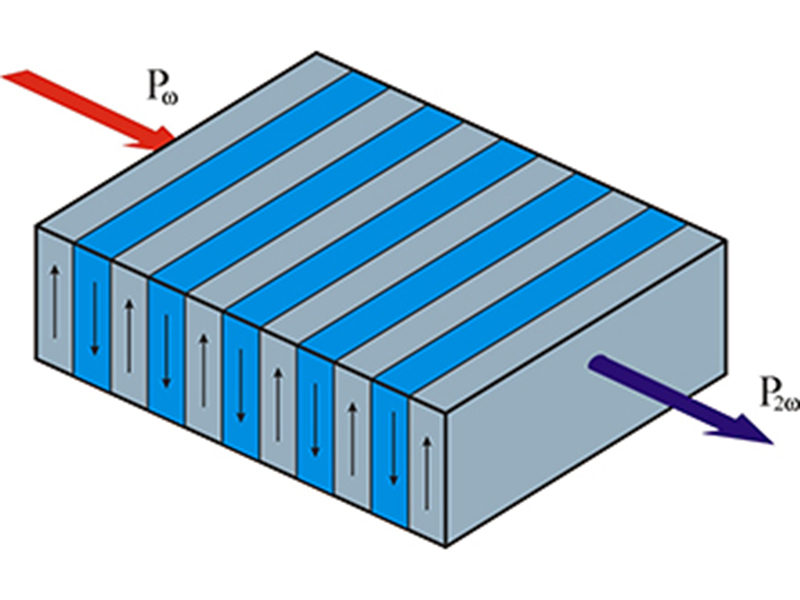
PPKTP enables quasi-phase matching without beam walk-off, the leading crystal for entangled-photon SPDC and wavelength conversion.
Request Information
Technical details
Quasi-Phase-Matched Crystal
Advantages
- QPM almost eliminates spatial walk-off between interacting beams, enabling longer interaction lengths and higher conversion efficiency than birefringent phase matching (BPM in single crystals).
- Highest effective nonlinear coefficient: PPKTP utilizes the largest nonlinear tensor element (d₃₃ = 16.9 pm/V), approximately three times larger than that of bulk KTP in birefringent phase matching.
- Broad phase-matching range: Customizable frequency conversion across the entire KTP transparency range (350–4000 nm) by selecting the appropriate poling period, without the wavelength limitations of birefringent phase matching.
- Superior thermal stability: PPKTP exhibits much lower temperature sensitivity than PPLN (3 μm/°C versus 52 μm/°C), enabling stable operation in fluctuating thermal environments.
- High damage threshold: Laser-induced damage threshold of 600 MW/cm² (with coating) at 1064 nm for 10 ns pulses, suitable for high-power and high-energy applications.
- Low photorefractive damage: Compared with PPLN and other ferroelectric crystals, PPKTP shows superior resistance to photorefractive effects, allowing room-temperature operation.
- Lower coercive field: The coercive voltage for domain reversal in KTP is only about one-tenth that of LiNbO₃, facilitating the fabrication of thicker periodically poled wafers (up to 3 mm) for large-aperture, high-power devices.
Typical Specifications
- Chemical formula: KTiOPO₄ (KTP)
- Crystal structure: Orthorhombic, space group Pna2₁; ferroelectric multiple domains
- Transparency range: 350-4500 nm
- Effective nonlinear coefficient: d_eff ≈ d₃₃ = 16.9 pm/V (Type-0); ~3× higher than birefringent KTP
- Poling period: Customizable (minimum 1.2 μm, accuracy 0.025 μm )
- Phase-matching type: Type-0, Type-I, and Type-II available
- Pump wavelength range: 730–3500 nm (Type-0 & 2 frequency conversions)
- Aperture size: Typical 1 × 2 mm²; up to 3 × 3 mm² available
- Crystal length: Up to 30 mm
- Absorption coefficient: <20 ppm/cm at 1064 nm (standard); ~40% lower at 532 nm for SPPKTP
- Damage threshold: 600 MW/cm² (coated, 1064 nm, 10 ns pulses)
- Surface flatness: λ/6 @ 633 nm, Convex or Concave faces are available.
- Operating temperature: 20-200 ℃ (customizable)
- Coating options: AR/AR, AR/HR-PR, DBAR, TBAR, IAD or IBS (extra-cavity or intra-cavity)
Main Applications
- Spontaneous parametric down-conversion (SPDC): PPKTP is the leading crystal for generating entangled photon pairs for quantum communication, quantum key distribution (QKD), and quantum imaging; Type-0 and Type-II configurations are available for polarization-entangled and energy-time-entangled sources.
- Squeezed light generation: Used in optical parametric oscillators for continuous-variable quantum information, quantum-enhanced metrology, and gravitational-wave detection; PPKTP offers high nonlinearity and low loss for sub-shot-noise measurements.
- Second-harmonic generation (SHG): Efficient frequency doubling for green and blue light generation; a bow-tie ring resonator with PPKTP achieved efficient 480 nm blue-light generation. PPKTP has demonstrated SHG conversion from 1319 nm to 659.5 nm.
- Optical parametric oscillators and amplifiers (OPO/OPA): Tunable visible and near-infrared generation (680–2000 nm) with green pump sources; PPKTP enables compact, efficient OPO designs without walk-off limitations.
- Quantum frequency conversion: Interfaces between different quantum systems and telecom wavelengths for quantum repeater and quantum network architectures.
- Heralded single-photon sources: PPKTP-based SPDC produces high-purity heralded single photons for quantum sensing and ultra-sensitive temperature measurement.
- Backward-wave OPO (BWOPO): Counter-propagating signal and idler waves enable cavity-free, compact, and robust OPO configurations with demonstrated efficiency >70%.
- Chirped and aperiodic poling: For broadband or tailored spectral characteristics, including removal of spectral side lobes for enhanced spectral purity in quantum applications.