KTP (KTiOPO₄) Single Crystal - Hydrothermal Method
Description
Hydrothermal KTP (H-KTP) features ultra-low ionic conductivity and high uniformity, enabling reliable high-average-power green SHG.
Request Information
Technical details
Advantages
- Hydrothermally grown KTP (H-KTP) exhibits significantly lower ionic conductivity (10⁻¹⁰ to 10⁻¹¹ Ω·cm) compared with Flux-grown KTP (10⁻⁶ to 10⁻⁸ Ω·cm), effectively suppressing electrochromic damage and gray-track formation under high-power 1064 nm laser irradiation.
- High laser damage threshold: Surface LIDT values up to 1.5 GW/cm² have been reported for hydrothermally grown KTP, compared with approximately 600 MW/cm² for flux-grown material under comparable conditions. A hydrothermal KTP crystal with a damage threshold of 9.5 GW/cm² at 1064 nm (TEM₀₀, 10 ns) has been demonstrated.
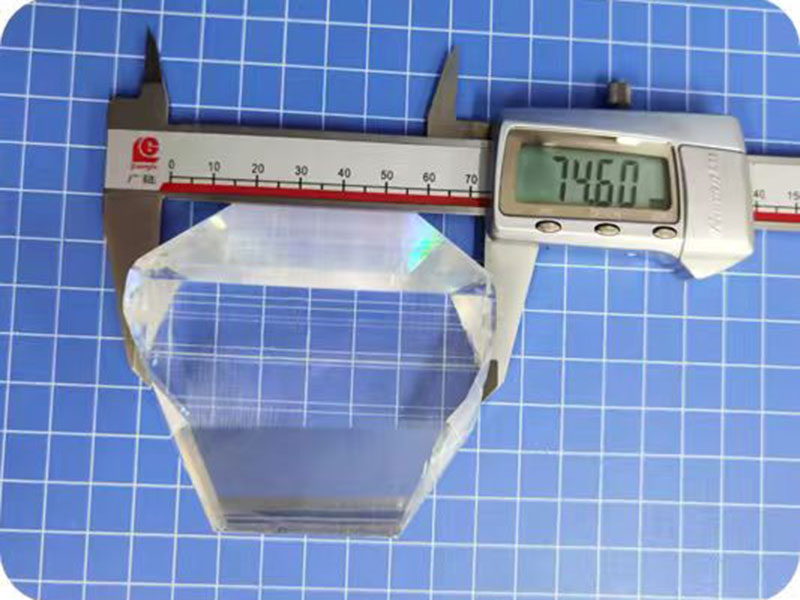
- Hydrothermal growth is scalable, with commercial autoclaves (Φ120 mm × 2.4 m) producing large single-domain crystals; dimensions up to 50 mm × 50 mm × 70 mm and masses of 300–400 g have been achieved .
- Single-domain structure: Hydrothermal growth occurs below the Curie temperature (936°C), and single-domain seeds ensure single-domain crystal growth, eliminating ferroelectric domain walls that reduce nonlinear conversion efficiency.
- Excellent optical homogeneity: Constant growth rate in the closed autoclave system yields uniform optical properties throughout the bulk crystal, with minimal chemical impurities.
Typical Specifications
- Chemical formula: KTiOPO₄
- Crystal structure: Orthorhombic, space group Pna2₁ (point group mm2)
- Lattice parameters: a = 6.404 Å, b = 10.616 Å, c = 12.814 Å
- Transparency range: 350–2500 nm
- SHG phase-matching range: 497–1800 nm (Type II)
- SHG phase-matching angle (1064→532 nm): 23.4° at 25°C
- Nonlinear coefficients: d₃₁ = 6.5 pm/V, d₃₂ = 5.0 pm/V, d₃₃ = 13.7 pm/V, d₁₅ = 6.1 pm/V, d₂₄ = 7.6 pm/V
- Electro-optic coefficients (at 632.8 nm): r₁₃ = 11.7 pm/V, r₂₃ = 16.23 pm/V, r₃₃ = 37.815 pm/V
- Conductivity: ~ 10⁻¹¹ Ω·cm
- Absorption coefficient: <0.1%/cm at 1064 nm; <1%/cm at 532 nm
- Damage threshold: ≥5 J/cm² (1064 nm, 10 ns, 10 Hz, AR-coated) ; up to 1.5 GW/cm² for H-KTP under specific conditions
- Density: 3.01 g/cm³
- Domain structure: Single domain
Main Applications
- High-average-power SHG: Frequency doubling of Nd:YAG and other Nd-doped lasers for green output, particularly in high-repetition-rate systems (>1 kHz) where flux-grown KTP suffers from gray-track degradation.
- Electro-optic Q-switches and Pockels cells: Hydrothermal KTP‘s low conductivity and high damage threshold make it suitable for high-repetition-rate electro-optic devices; half-wave voltages of 1200-3500 V (depending on aperture) with extinction ratios >25 dB have been demonstrated .
- Optical parametric oscillators and amplifiers: Tunable near- to mid-IR generation (0.6-2.5 μm).
- High-power laser systems: Suitable for laser ranging, LIDAR, medical lasers, and industrial lasers requiring durability and resistance to gray-track damage.
Hydrothermal Growth Process
Hydrothermal KTP growth is conducted in a sealed autoclave under high pressure (120–180 MPa) and moderate temperature (400–550°C), using a nutrient zone and seed crystal arrangement. A typical mineralizer solution consists of 2.0 M K₂HPO₄ + 0.1 M KH₂PO₄ + 1 wt% H₂O₂ . Growth rates of approximately 0.15 mm/day along the (011) direction have been achieved . The process typically requires weeks to months, and the closed-system growth environment minimizes chemical impurities and oxygen vacancies, which contributes to the superior gray-track resistance of the resulting crystals .