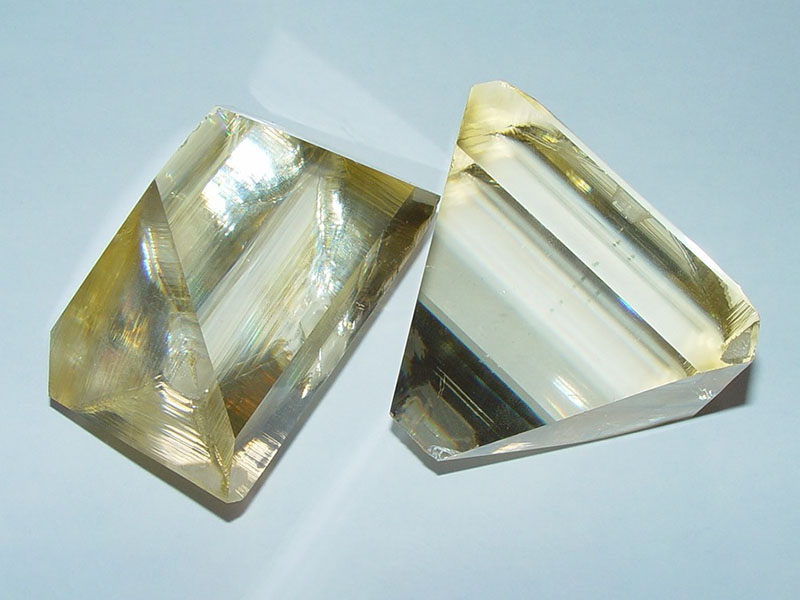
KTP (KTiOPO₄) Single Crystal - Flux-Grown
Description
Flux-grown KTP delivers ~15× the nonlinearity of KDP, the preferred crystal for intracavity doubling of Nd:YAG to 532 nm green.
Request Information
Technical details
Advantages
- Excellent nonlinear coefficient approximately 15 times that of KDP, making it the preferred frequency-doubling crystal for Nd:YAG and other Nd-doped lasers emitting near 1.06 μm.
- Laser damage threshold: >500 MW/cm² at 1064 nm (10 ns pulses), roughly 10 times that of LiNbO₃.
- Broad transparency range: 350-4500 nm (0 transmittance defined).
- Low dielectric constant and large electro-optic coefficients: r₃₃ = 36.3 pm/V, enabling high-frequency electro-optic modulation and Q-switching applications.
- Non-hygroscopic and thermally stable: Stable below 900°C, resistant to moisture under normal handling conditions.
Typical Specifications
- Crystal structure: Orthorhombic, point group mm2; space group Pna2₁
- Lattice constants: a = 12.814 Å, b = 6.404 Å, c = 10.616 Å; α = β = γ = 90°
- Transparency range: 350-4500 nm (0 transmittance defined)
- Refractive indices:
- @1064 nm: nₐ = 1.7377, nᵧ = 1.7453, n_z = 1.8297
- @532 nm: nₐ = 1.7780, nᵧ = 1.7886, n_z = 1.8887
- Nonlinear coefficients: d₃₁ = 6.5 pm/V, d₃₂ = 5.0 pm/V, d₃₃ = 13.7 pm/V, d₁₅ = 6.1 pm/V, d₂₄ = 7.6 pm/V
- Electro-optic coefficients (low frequency): r₁₃ = 9.5 pm/V, r₂₃ = 15.7 pm/V, r₃₃ = 36.3 pm/V, r₄₂ = 9.3 pm/V, r₅₁ = 7.3 pm/V
- Thermo-optic coefficients (10⁻⁶/K): dnₐ/dT = 6.1, dnᵦ/dT = 8.3, dn_c/dT = 14.5
- Laser damage threshold: >500 MW/cm² @1064 nm, 10 ns
- Mohs hardness: ~5
- Density: ~3.0 g/cm³
- Curie temperature: ~936°C (ferroelectric-to-paraelectric transition)
Sellmeier equations (λ in μm):
nₐ² = 3.29100 + 0.04140/(λ² − 0.03978) + 9.35522/(λ² − 31.45571)
nᵦ² = 3.45018 + 0.04341/(λ² − 0.04597) + 16.98825/(λ² − 39.43799)
n_c² = 4.59423 + 0.06206/(λ² − 0.04763) + 110.80672/(λ² − 86.12171)
Main Applications
- Intracavity frequency doubling of Nd:YAG lasers: 33 W average green output (532 nm) demonstrated with acousto-optic Q-switching at 25 kHz; 6.5 W completely continuous green output achieved.
- Optical parametric oscillators (OPOs): Widely used for tunable near- to mid-IR generation.
- Electro-optic modulators and Q-switches: High-frequency operation up to 1 MHz; suitable for amplitude modulation due to stable electro-optic properties insensitive to frequency and temperature.
- Sum-frequency generation (SFG): Red, yellow, and blue visible radiation generation.
- Laser ranging and remote sensing: Polarized output and thermal stability suited for LIDAR and environmental monitoring.
Notes on Flux-Grown KTP
Flux-grown KTP exhibits higher ionic conductivity (resistivity in the 10⁸ Ω·cm range) compared with hydrothermally grown material (>10¹¹ Ω·cm), attributable to K⁺ ion conduction via vacancy mechanisms. This leads to the well-known “gray track” effect under high-power 1064 nm laser irradiation, where absorption increases along the beam path. Modified flux growth techniques have produced “gray-track-resistant” KTP with absorption maintained at ~1.05 × 10⁻⁴/cm after 1000 s exposure to 120 kW/cm² (1064 nm) plus 10 kW/cm² (532 nm). Compared with hydrothermal KTP, flux-grown crystals typically show somewhat lower optical damage thresholds but offer advantages in crystal size and cost.