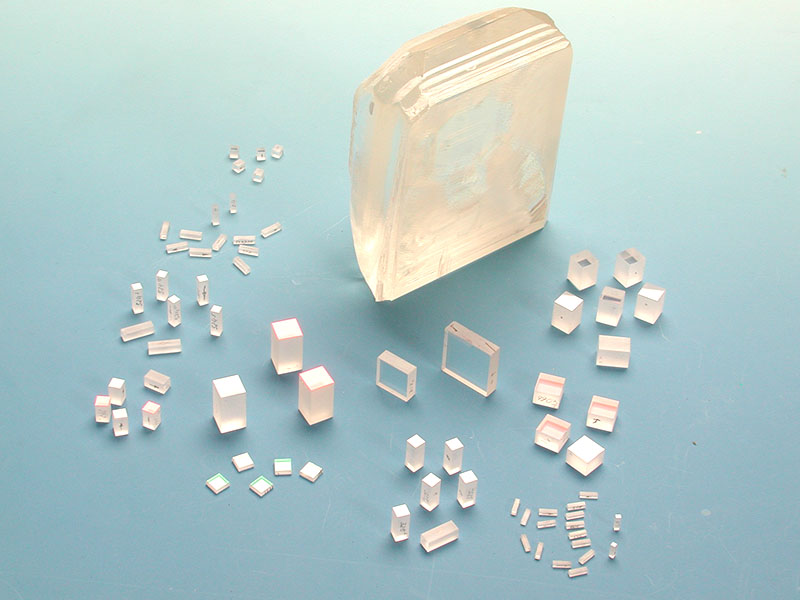
KGW (KGd(WO₄)₂, Potassium Gadolinium Tungstate) Single Crystal
Description
KGW (KGd(WO₄)₂) is the leading Raman crystal, delivering efficient stimulated Raman scattering for picosecond wavelength shifting.
Request Information
Technical details
Advantages
- Transparency range 0.35–5.5 μm, with high optical quality suitable for demanding laser applications.
- Two intense Raman shifts: 901 cm⁻¹ (p[mm]p) and 768 cm⁻¹ (p[gg]p), polarization-dependent, making KGW an excellent stimulated Raman scattering (SRS) crystal for frequency conversion.
- High Raman gain: 11 cm/GW at 532 nm and 3 cm/GW at 1064 nm in the picosecond transient regime, enabling efficient Raman shifting for ultrashort pulse applications.
- Relatively high thermal conductivity: 2.6–3.8 W/(m·K) depending on crystallographic orientation, providing good heat dissipation under high-power operation.
- Versatile rare-earth doping host: Gd³⁺ sites can be substituted by Nd³⁺, Yb³⁺, Er³⁺, Tm³⁺, Ho³⁺, Sm³⁺, Eu³⁺, and Pr³⁺, enabling a wide range of laser and upconversion applications.
- Good mechanical stability: Mohs hardness of 4–5, suitable for high optical energy and power operation.
Typical Specifications
- Crystal structure: Monoclinic, space group C2/c (α-phase, low-temperature form)
- Lattice parameters: a = 10.652 Å, b = 10.374 Å, c = 7.582 Å
- Transparency range: 0.3–5.5 μm
- Refractive indices @ 1064 nm: nₚ = 1.982, nₘ = 2.010, n_g = 2.061
- Raman frequency shifts: 901 cm⁻¹ (p[mm]p), 767–768 cm⁻¹ (p[gg]p)
- Raman linewidth: 5.4 cm⁻¹ @ 901 cm⁻¹; 6.4 cm⁻¹ @ 767 cm⁻¹
- Dephasing time: 2 ps
- Thermal conductivity: Kₐ = 2.6 W/(m·K), K_b = 3.8 W/(m·K), K_c = 3.4 W/(m·K)
- Thermo-optic coefficients: dnₚ/dT = −15.7 × 10⁻⁶/K, dnₘ/dT = −11.8 × 10⁻⁶/K, dn_g/dT = −17.3 × 10⁻⁶/K
- Density: 7.27 g/cm³
- Mohs hardness: 4–5
- Melting point: 1075 °C
- Damage threshold: >10 J/cm² @ 1064 nm, 10 ns; >10 GW/cm²
- Standard Fabrication Specifications:
- Orientation: b-cut
- Clear aperture: >90%
- Surface quality: 10/5 Scratch/Dig
- Surface flatness: <λ/8 @ 632.8 nm
- Wavefront distortion: <λ/4 @ 632.8 nm
- Parallelism: <20 arcsec
- Perpendicularity: <10 arcmin
- Coatings: AR (R < 0.5%) @ 500–650 nm; AR/AR @ 500–600 nm + 1000–1200 nm available
Main Applications
- Stimulated Raman scattering (SRS): KGW is the primary choice for Raman shifting in picosecond laser systems, enabling wavelength conversion beyond the fundamental laser output. The two Raman shifts (901 and 768 cm⁻¹) provide flexibility in selecting output wavelengths.
- Raman lasers: Diode-pumped Nd:GdVO₄/KGW Raman lasers have demonstrated CW operation at 1525 nm, generating specific wavelengths for spectroscopy and sensing applications.