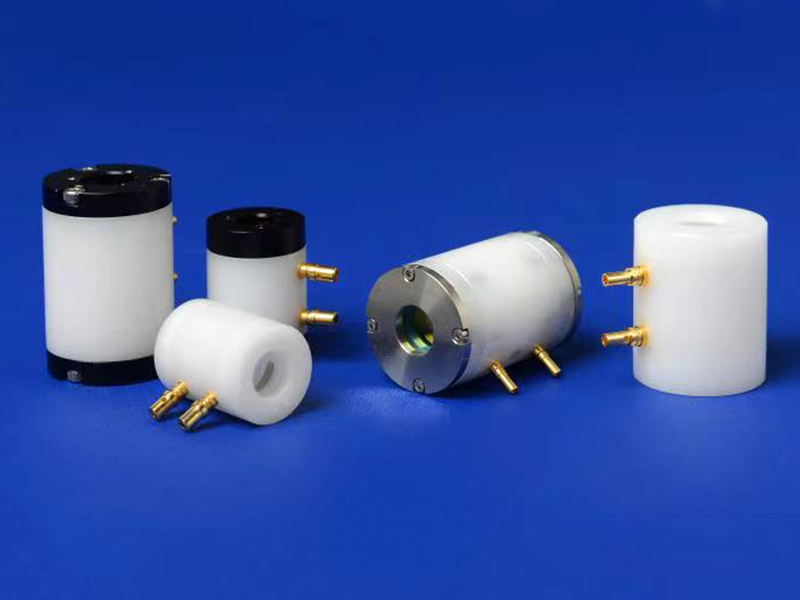
KD₂PO₄ (DKDP, Potassium Dideuterium Phosphate) Single Crystal
Description
DKDP (KD₂PO₄) extends transmission to 2150 nm and is the primary THG crystal and Pockels-cell material for high-energy laser systems.
Request Information
Technical details
Advantages
- Broader transparency range 200–2150 nm than KDP (200–1500 nm).
- Much larger electro-optic coefficient: r₆₃ = 25 pm/V (versus 10.3 pm/V for KDP), enabling significantly lower half-wave voltage (2.98 kV @ 546 nm vs. 7.65 kV for KDP).
- High laser damage threshold: >3 GW/cm² at 1064 nm (ns pulses), suitable for high-power laser systems .
- Large crystal growth capability: Can be grown to very large apertures, making it the material of choice for ICF and high-power laser facilities.
- Tunable deuterium content: Properties can be engineered by adjusting deuteration level (70% or >98%), enabling optimization for specific phase-matching and electro-optic applications.
- Good UV transmission and high birefringence: Well-suited for harmonic generation and electro-optic modulation.
Typical Specifications
- Chemical formula: KD₂PO₄ (deuteration level 70%, up to 99%)
- Crystal structure: Tetragonal, space group I4̄2d (point group 4̄2m)
- Transparency range: 200–2150 nm
- Refractive indices @1064 nm: n₀ = 1.4948, nₑ = 1.4554
- Nonlinear coefficient: d₃₆ = 0.40 pm/V
- Electro-optic coefficients: r₄₁ = 8.8 pm/V; r₆₃ = 25 pm/V
- Longitudinal half-wave voltage: Vπ = 2.98 kV @ 546 nm
- Absorption coefficient: 0.005–0.006 cm⁻¹
- Laser damage threshold: >3 GW/cm² @1064 nm (ns pulses); >5 J/cm² @1064 nm, 10 ns
- Mohs hardness: 2.5
- Density: 2.355 g/cm³
- Curie temperature: ~222 K (tetragonal-to-monoclinic transition)
- Extinction ratio (electro-optic devices): 30 dB (typical)
- Hygroscopic susceptibility: High; requires protective coating or controlled environment
Sellmeier equations (λ in μm) :
n₀² = 1.9575544 + 0.2901391λ²/(λ² − 0.0281399) − 0.02824391λ² + 0.004977826λ⁴
nₑ² = 1.5005779 + 0.6276034λ²/(λ² − 0.0131558) − 0.01054063λ² + 0.002243821λ⁴
Main Applications
- DKDP (typically 70% deuterated) is the primary THG crystal, >98%-deuterated DKDP is used for Pockels cells in laser fusion energy programs.
- High-power harmonic generation Second (532 nm), third (355 nm), and fourth (266 nm) of Nd:YAG and Nd:glass lasers.
- Electro-optic Q-switches and Pockels cells: The large r₆₃ coefficient (25 pm/V) and low half-wave voltage make DKDP the material of choice for high-power electro-optic modulators, Q-switches, and Pockels cells .
- Optical parametric chirped-pulse amplification (OPCPA): DKDP crystals with engineered deuteration levels (70-98%) enable broadband OPCPA for ultra-intense femtosecond laser systems, including petawatt-class lasers .
- Gradient-deuterium THG and broadband frequency conversion: DKDP crystals with spatially varying deuterium content enable group-velocity matching and rapid adiabatic passage for broadband THG, achieving efficiencies up to 36% .
- Terahertz wave generation: Demonstrated as a potential terahertz source.