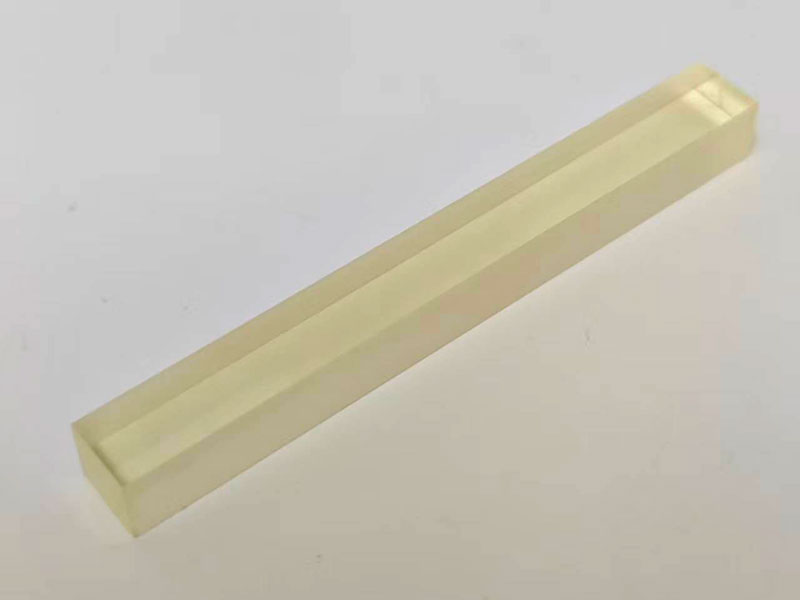
Ho:YLF (Holmium-Doped Yttrium Lithium Fluoride) Single Crystal
Description
Ho:YLF combines a ~14 ms upper-state lifetime with eye-safe 2 µm emission, the transmitter of choice for coherent Doppler wind LIDAR.
Request Information
Technical details
Advantages
- Long fluorescence lifetime: Ho:YLF exhibits an upper-state lifetime of approximately 14 ms, significantly longer than Ho:YAG (~7 ms), enabling superior energy storage for Q-switched and high-energy pulsed operation.
- Large emission cross-section: Approximately 1.8 × 10⁻²⁰ cm² at 2050 nm (π-polarization), providing high gain and efficient energy extraction.
- Natural birefringence eliminates thermal depolarization: The anisotropic YLF host is intrinsically birefringent, which greatly exceeds thermally induced birefringence, preventing depolarization losses common in isotropic hosts.
- Negative thermo-optic coefficient: The negative dn/dT of YLF partially compensates for positive thermal lensing caused by end-face expansion at high pump powers, improving beam quality and power scalability.
- Low upconversion losses: Fluoride hosts exhibit significantly lower energy-transfer upconversion losses compared with oxide crystals such as Ho:YAG, enhancing efficiency in quasi-three-level operation.
- Room-temperature high-power operation achieved: Recent advances have demonstrated the first room-temperature Ho:YLF composite thin-disk laser, overcoming the traditional need for cryogenic cooling.
Typical Specifications
- Chemical formula: Ho³⁺:LiYF₄ (Ho:YLF)
- Crystal structure: Tetragonal, scheelite type, space group I4₁/a
- Lattice parameters: a = 5.16 Å, c = 10.85 Å
- Ho doping concentration: 0.5–2.0 at.%
- Laser transition: ⁵I₇ → ⁵I₈
- Laser wavelength: ~2.05–2.06 μm (π-polarization: 2.05 μm; σ-polarization: 2.06 μm)
- Emission cross-section: 1.8 × 10⁻²⁰ cm² (π) at 2050 nm; 1.555 × 10⁻²⁰ cm² (π)
- Absorption peak wavelength: ~1.94 μm (in-band pumping)
- Absorption cross-section: ~1.0–1.2 × 10⁻²⁰ cm² at 1.94 μm (π)
- Fluorescence lifetime: ~14 ms
- Thermal conductivity: ~6 W/(m·K)
- Thermo-optic coefficient (dn/dT): −4.6 × 10⁻⁶/K (t/c); −6.6 × 10⁻⁶/K (t/a)
- Quantum defect: ~5.4% (in-band pumping at 1.94 μm)
- Damage threshold: ~18.9 GW/cm² (bulk, 4.6–10 ns pulses)
- Refractive indices: nₑ ≈ 1.4481, nₒ ≈ 1.4704 (at 1064 nm, YLF host)
- Density: ~3.99 g/cm³ (YLF host)
- Melting point: ~819 °C (YLF host)
- Mohs hardness: 4–5 (relatively low, requires careful handling)
Standard Fabrication Specifications
- Growth method: Czochralski (CZ) method under CF₄ atmosphere
- Orientation: a-cut for polarized output
- Standard dimensions: Rods up to 5 × 4 × 60 mm³ (typical amplifier rods); thin disks up to 8 × 8 × 0.5 mm
- Surface quality: 10/5 Scratch/Dig
- Surface flatness: λ/8 @ 632.8 nm
- AR coating: Available at 1.9 μm and 2.1 μm
Main Applications
- Doppler wind LIDAR: Ho:YLF lasers are used as transmitters in coherent Doppler wind LIDAR systems for wind field measurement, operating at 2 μm with eye-safe characteristics and low atmospheric attenuation.
- CO₂ differential absorption LIDAR (DIAL): The output spectrum of Ho:YLF can be tuned over CO₂ absorption lines, enabling precise monitoring of atmospheric CO₂ concentrations.
- High-energy pulsed amplifiers: Ho:YLF MOPA systems have achieved 280 W output power with 14.5 ns pulse width at 1 kHz, representing the highest pulse energy for 2 μm lasers at kHz repetition rates.
- Room-temperature thin-disk lasers: A composite Ho:YLF thin-disk laser has achieved 26.5 W continuous-wave output with 42% slope efficiency and near-diffraction-limited beam quality (M² < 1.2) at room temperature.
- Optical refrigeration: Ho:YLF is a promising material for mid-IR optical refrigeration, with potential to achieve lower temperatures and higher cooling efficiency than Tm-doped systems.
- Mid-infrared OPO pumping: The 2.05 μm output serves as an efficient pump source for ZGP-based optical parametric oscillators generating 3-5 μm radiation.
- Q-switched high-energy lasers: Cryogenic Ho:YLF has delivered 550 mJ pulse energy at 1 Hz, the highest reported for Ho:YLF systems.