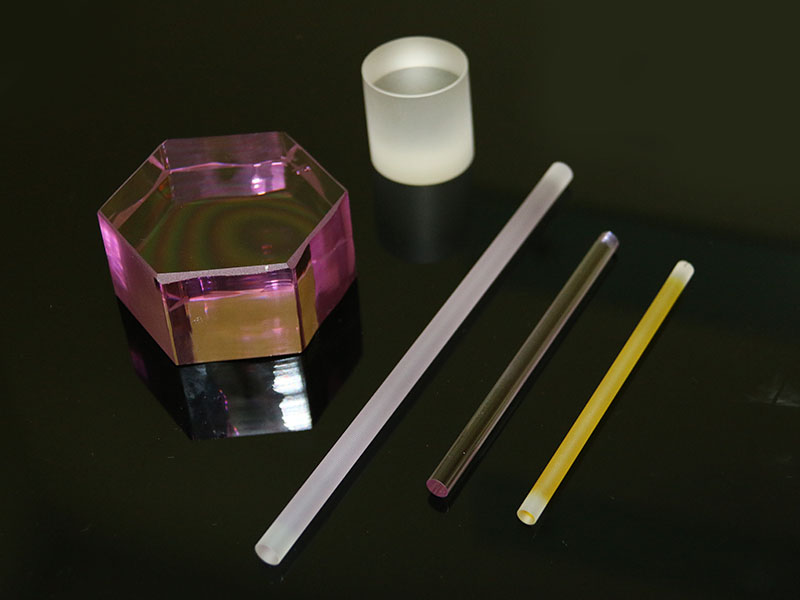
Ho:YAG (Holmium-Doped Yttrium Aluminum Garnet) Single Crystal
Description
Ho:YAG delivers eye-safe 2.1 µm output strongly absorbed by tissue, widely used for lithotripsy, prostate and soft-tissue surgery.
Request Information
Technical details
Advantages
- Eye-safe 2 μm laser emission: Ho:YAG operates on the ⁵I₇ → ⁵I₈ transition with output near 2.1 μm, located in the eye-safe spectral band with high atmospheric transmittance, ideal for LIDAR, ranging, and remote sensing applications.
- Strong water absorption for medical applications: The 2.1 μm wavelength coincides with a strong absorption peak of water molecules, resulting in a penetration depth of only a few tens of micrometers in human tissue, enabling precise cutting and coagulation with minimal thermal damage to surrounding healthy tissue.
- Long upper-state lifetime for energy storage: Fluorescence lifetime of approximately 7–8.5 ms, enabling efficient Q-switched and pulsed operation with high pulse energies.
- Low up-conversion and re-absorption losses: Ho:YAG exhibits minimal energy loss mechanisms, contributing to high slope efficiency and efficient energy extraction.
- Direct diode pumping at 1.9 μm: The absorption peak at 1908 nm allows in-band pumping with Tm-based fiber or solid-state lasers, achieving low quantum defect and high overall efficiency.
- Excellent thermo-mechanical properties inherited from YAG host: High thermal conductivity (14 W/(m·K) at 20°C), Mohs hardness of 8.5, and chemical stability enable reliable high-power operation.
Typical Specifications
- Chemical formula: Ho³⁺:Y₃Al₅O₁₂
- Crystal structure: Cubic garnet, space group Ia3d
- Lattice constant: a = 12.01 Å
- Ho doping concentration: 0.2–3 at.% (customizable)
- Laser transition: ⁵I₇ → ⁵I₈
- Laser wavelength: 2.05-2.12 μm (primary: ~2.09 μm)
- Pump wavelength: 1908 nm (in-band diode pumping)
- Absorption cross-section: 1.09 × 10⁻²⁰ cm² (at 1908 nm)
- Emission cross-section: 1.14 × 10⁻²⁰ cm²
- Fluorescence lifetime: ~7-8.5 ms
- Quantum efficiency: ~1
- Refractive index: 1.82 @ 1.03 μm
- Density: 4.56 ± 0.04 g/cm³
- Melting point: 1970 °C
- Mohs hardness: 8.5
- Thermal conductivity: 14 W/(m·K) @ 20°C; 10.5 W/(m·K) @ 100°C
- Thermo-optic coefficient (dn/dT): 7.3 × 10⁻⁶/K
- Thermal expansion: [111]: 7.8 × 10⁻⁶/K; [100]: 8.2 × 10⁻⁶/K; [110]: 7.7 × 10⁻⁶/K
- Damage threshold: ≥500 MW/cm² @ 2090 nm, 10 ns, 10 Hz
Standard Fabrication Specifications
- Orientation: <111> ± 5°
- Diameter: 2-20 mm; Length: 1-150 mm (customizable)
- Dimension tolerance: Diameter +0/−0.1 mm; Length +0.5/−0 mm
- Parallelism: ≤10 arc sec
- Perpendicularity: ≤5 arc min
- Surface quality: 10/5 Scratch/Dig
- Surface flatness: ≤λ/10 @ 632.8 nm
- Wavefront distortion: ≤λ/8 per inch @ 632.8 nm
- Clear aperture: >95%
- Chamfer: 0.2 mm at 45o
- AR coating: R < 0.2% @ 2090 nm; R < 1% @ 1908 nm
Main Applications
- Ho:YAG lasers are widely used for lithotripsy, prostate vaporization, soft-tissue incision, and ophthalmology (e.g., glaucoma treatment), benefiting from strong water absorption and minimal thermal damage.
- LIDAR and remote sensing: Eye-safe 2.1 μm output enables coherent Doppler wind LIDAR, differential absorption LIDAR, and laser rangefinders with high atmospheric transmission.
- Mid-infrared OPO pumping: The 2.1 μm output serves as an ideal pump source for optical parametric oscillators based on ZGP or other nonlinear crystals to generate 3–5 μm mid-infrared radiation.
- Material processing: Ho:YAG lasers are used for laser cutting, welding, and marking, particularly for plastics and other materials with strong 2 μm absorption.
- Military and countermeasures: 2 μm eye-safe lasers are deployed in target designation, rangefinding, and photoelectric countermeasure systems.
- Scientific research: Ho:YAG serves as a pump source for mid-IR OPOs, gas spectroscopy, and as a model system for studying quasi-three-level laser dynamics.