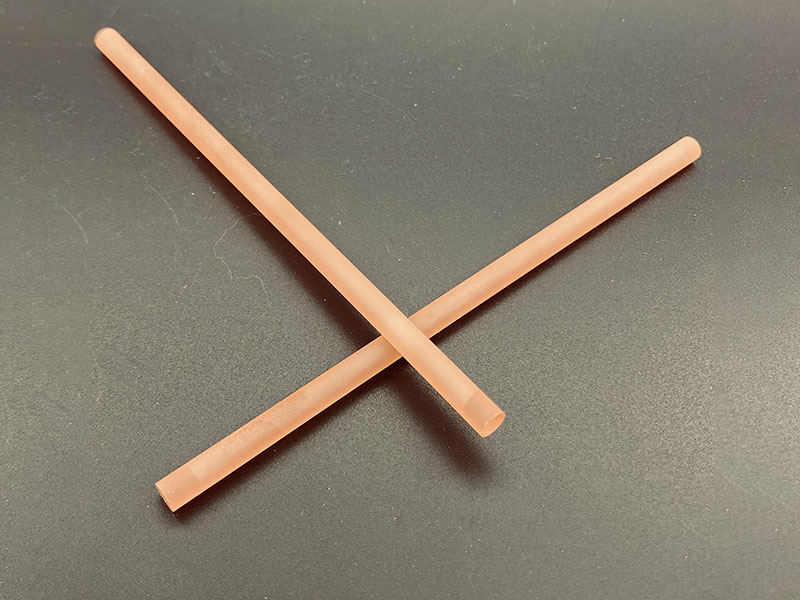
Er:YAG (Erbium-Doped Yttrium Aluminum Garnet) Single Crystal
Description
Er:YAG emits at 2.94 µm where water absorption peaks, the leading laser crystal for dental hard-tissue ablation and precise surgery.
Request Information
Technical details
Advantages
- Dual-wavelength emission capability: Er:YAG exhibits two distinct laser transitions depending on doping concentration. At high doping (~50 at.%), it emits at 2940 nm (⁴I₁₁/₂ → ⁴I₁₃/₂), which coincides with the strong absorption peak of water and hydroxyapatite, making it ideal for medical ablation . At low doping (<1 at.%), it emits at ~1640 nm (⁴I₁₃/₂ → ⁴I₁₅/₂), an "eye-safe" wavelength suitable for telemetry, LIDAR, and free-space communications.
- High water absorption coefficient at 2940 nm: The 2940 nm output is strongly absorbed by water and biological tissue, enabling precise ablation with minimal thermal damage to surrounding tissue.
- Excellent thermo-mechanical properties inherited from YAG host: High thermal conductivity (14 W/(m·K)), high damage threshold (>500 MW/cm²), chemical stability, and UV resistance.
- Room-temperature operation: Unlike some mid-IR laser materials, Er:YAG operates efficiently at room temperature.
- In-band pumping capability: The ⁴I₁₅/₂ → ⁴I₁₃/₂ transition allows direct diode pumping at 1470 nm or 1532 nm, achieving high quantum efficiency (>90%).
- Compatibility with fiber and ceramic forms: Er:YAG can be grown as single-crystal fibers via micro-pulling-down (μ-PD) and fabricated as transparent ceramics, enabling compact and scalable laser designs.
Typical Specifications
- Chemical formula: Er³⁺:Y₃Al₅O₁₂
- Crystal structure: Cubic garnet, space group Ia3d
- Lattice constant: a = 12.01 Å
- Er doping concentration: 0.5-50 at.% (0.5–1 at.% for 1.6 μm emission; ~50 at.% for 2.94 μm emission)
- Laser wavelengths: 2940 nm (high doping); ~1640 nm (low doping)
- Laser transitions: ⁴I₁₁/₂ → ⁴I₁₃/₂ (2940 nm); ⁴I₁₃/₂ → ⁴I₁₅/₂ (1640 nm)
- Pump bands: 600–800 nm (flashlamp or Ti:sapphire); 1470 nm or 1532 nm (in-band diode pumping)
- Absorption bandwidth: ~10 nm at 1470 nm; <1 nm at 1532 nm (requires spectral narrowing for efficient pumping)
- Emission cross-section: 3 × 10⁻²⁰ cm² @ 2940 nm
- Refractive index: 1.79 @ 2940 nm
- Photon energy: 6.75 × 10⁻²⁰ J @ 2940 nm
- Density: 4.56 g/cm³
- Melting point: 1970 °C
- Mohs hardness: 8.5
- Thermal conductivity: 14 W/(m·K) @ 20°C
- Fluorescence lifetime (⁴I₁₃/₂ → ⁴I₁₅/₂): ~6.67 ms (ceramic, 50 at.% Er); ~7.53 ms (Yb,Er co-doped ceramic)
- Damage threshold: >500 MW/cm²
Standard Fabrication Specifications
- Orientation: <111> ± 0.5°
- Diameter: 3-6 mm (rod); up to 15 mm (larger diameters available)
- Length: 50–120 mm
- Dimension tolerance: Diameter ±0.1 mm; Length ±0.5 mm
- Surface quality: 10/5 Scratch/Dig
- Surface flatness: λ/8 @ 633 nm
- Parallelism: ≤30 arc sec
- Perpendicularity: ≤15 arc min
- Chamfer: ≤0.2 mm × 45°
- AR coating: R ≤ 0.2% @ 2940 nm
Main Applications
- Dental hard-tissue ablation: Er:YAG lasers are widely used for caries removal, cavity preparation, enamel etching, and bone cutting in oral surgery. The 2940 nm wavelength is absorbed by both water and hydroxyapatite, enabling precise tooth and bone ablation without vibration-induced microfractures.
- Dermatology and skin resurfacing: Used for treating acne scarring, deep rhytides, melasma, and skin resurfacing procedures, benefiting from precise tissue ablation with minimal thermal damage.
- Soft-tissue surgery: Applied in general surgery, urology, gynecology, ENT, and thoracic surgery for incision, excision, vaporization, and coagulation of soft tissue.
- Bone surgery and implantology: Effective for osseous tissue cutting, osteotomy, apicoectomy, and implant site preparation in oral and maxillofacial surgery.
- Eye-safe laser systems (1.6 μm): Low-doped Er:YAG (~0.5-1 at.%) emits at ~1640 nm, suitable for free-space communications, LIDAR, laser rangefinders, and remote sensing.
- LIDAR and wind sensing: High-energy single-frequency Er:YAG lasers at 1645 nm have been demonstrated for wind LIDAR applications, with pulse energies up to 28.6 mJ and pulse durations maintained at hundreds of nanoseconds .
- Optical parametric oscillator pumping: The 2.94 μm output serves as a pump source for OPOs to generate longer mid-infrared wavelengths.