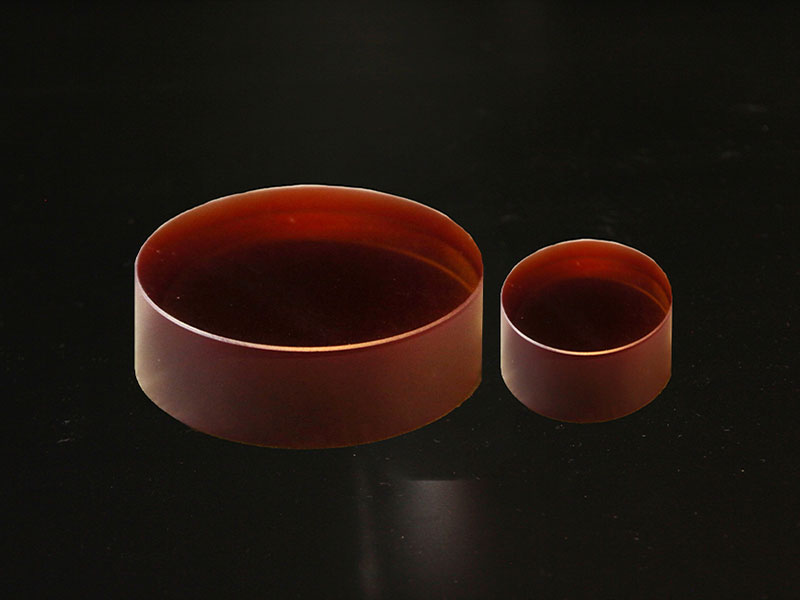
Cr⁴⁺:YAG (Chromium-Doped Yttrium Aluminum Garnet) Single Crystal
Description
Cr⁴⁺:YAG is the standard passive Q-switch crystal for Nd:YAG, Nd:YLF and Nd:YVO₄ lasers, with large cross-section and high reliability.
Request Information
Technical details
Advantages
- Excellent passive Q-switching performance: Cr⁴⁺:YAG provides a large absorption cross-section in the 0.9–1.2 μm spectral region, making it ideal for passive Q-switching of Nd:YAG, Nd:YLF, Nd:YVO₄, and Yb:YAG lasers.
- Superior thermo-mechanical properties: High thermal conductivity (0.11–0.121 W·cm⁻¹·K⁻¹) and Mohs hardness of 8.5 enable reliable operation under high thermal loads.
- High damage threshold: >500 MW/cm² (or >10 J/cm² at 1064 nm, 10 ns), allowing use in high-power laser systems.
- Robust alternative to dyes: Cr⁴⁺:YAG is more chemically stable, durable, and UV-resistant than organic dye saturable absorbers, with a long operational lifetime.
- Simple and compact configuration: Passive Q-switches eliminate the need for high-voltage power supplies and electro-optic drivers, reducing system size and complexity.
- Diffusion bonding capability: Can be diffusion-bonded with Nd:YAG or other doped YAG crystals to form compact monolithic laser oscillators.
Typical Specifications
- Chemical formula: Cr⁴⁺:Y₃Al₅O₁₂
- Crystal structure: Cubic garnet, space group Ia3d
- Lattice constant: 12.01 Å
- Orientation: [100] or [110] < ±0.5°
- Working wavelength range: 900–1200 nm; peak absorption around 1060 nm
- Ground-state absorption cross-section (@1064 nm): 4–5 × 10⁻¹⁸ cm²
- Excited-state absorption cross-section (@1064 nm): ~8.2 × 10⁻¹⁹ cm²
- Recovery time: 4–8.5 μs (fluorescence lifetime: ~3.4 μs)
- Initial transmission: 10–90% (customizable)
- Optical density: 0.1–0.8
- Absorption coefficient: 1.0–7 cm⁻¹ (typical for Q-switches: 3–6 cm⁻¹)
- Cr⁴⁺ concentration: 0.5–3 mol%
- Charge compensation ions: Ca²⁺, Mg²⁺
- Density: 4.56 g/cm³
- Mohs hardness: 8.5
- Melting point: 1970°C
- Thermal conductivity: 0.11–0.121 W·cm⁻¹·K⁻¹
- Thermal expansion coefficient: 7.7–8.2 × 10⁻⁶ /°C (orientation-dependent)
- Refractive index (@1064 nm): 1.82–1.83
- Damage threshold: >500 MW/cm² (or >10 J/cm² at 1064 nm, 10 ns)
- Surface quality: 10/5 Scratch/Dig
- Surface flatness: <λ/8 @ 632 nm
- AR coating: R ≤ 0.2% @ 1064 nm
Main Applications
- The primary application. Cr⁴⁺:YAG is used as a saturable absorber in Nd:YAG, Nd:YLF, Nd:YVO₄, and Yb:YAG laser systems to generate high-peak-power nanosecond pulses.
- Laser rangefinders and LIDAR: Compact passive Q-switched lasers for ranging, remote sensing, and light detection applications.
- LIBS systems: Laser-induced breakdown spectroscopy requiring short, high-energy pulses.
- Laser marking and precision processing: Industrial laser systems for marking, micromachining, and material processing.
- Medical lasers: Pulse control in dermatological and surgical laser systems.
- Q-switched mode-locking: Under high intracavity intensity, excited-state absorption in Cr⁴⁺:YAG enables simultaneous Q-switching and mode-locking, producing sub-nanosecond pulse trains.
- Tunable near-infrared lasers: Cr⁴⁺:YAG also functions as a tunable laser crystal with emission in the 1350–1600 nm range.