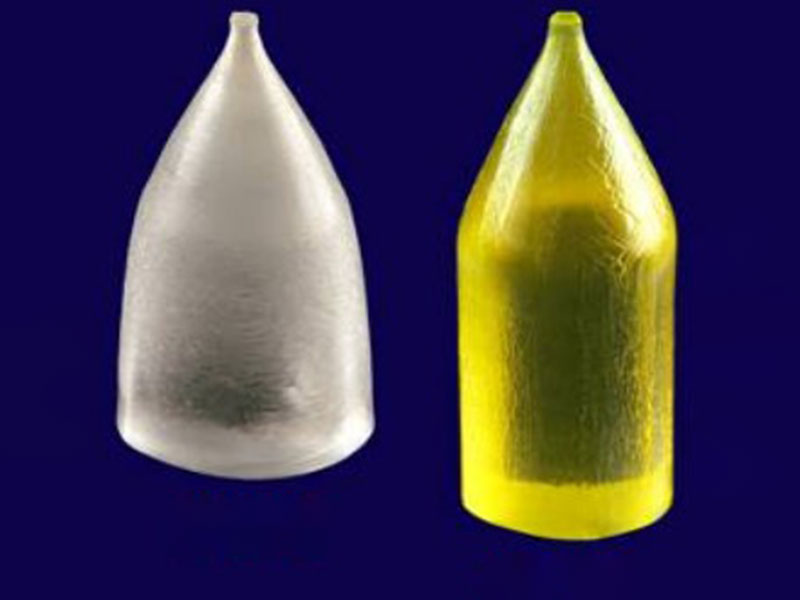
Ce:YAG (Cerium-Doped Yttrium Aluminum Garnet) Single Crystal
Description
Ce:YAG single crystals reach near-unity quantum efficiency, the preferred phosphor converter for high-power white laser lighting and LEDs.
Request Information
Technical details
Advantages
- Ultra-high quantum efficiency: Ce:YAG single crystals achieve internal quantum efficiencies up to 92% under blue excitation, enabling exceptional luminescence conversion efficiency.
- Fast luminescence decay: The Ce³⁺ 5d→4f transition exhibits a decay time of 60–100 ns, effectively preventing optical saturation at high excitation power densities.
- High thermal conductivity and stability: The YAG host provides thermal conductivity of ~10 W/(m·K), approximately 10 times that of conventional phosphor powders, with excellent lumen maintenance (97% at 200°C for single crystals).
- High saturation threshold under laser excitation: Single-crystal Ce:YAG demonstrates a luminescence saturation threshold of 12 W/mm² under 450 nm laser diode excitation, making it suitable for high-power laser lighting.
- Excellent scintillation performance: Light yield exceeding 20,000-30,000 photons/MeV with energy resolution of 14% (FWHM) at 662 keV, suitable for radiation detection applications.
- Non-hygroscopic and chemically inert: Superior environmental stability compared with hygroscopic scintillators such as CsI:Tl, enabling long-term operation without protective encapsulation.
Typical Specifications
- Chemical formula: Ce³⁺:Y₃Al₅O₁₂
- Crystal structure: Cubic garnet, space group Ia3d
- Lattice constant: a = 12.01 Å
- Ce doping concentration: 0.05–0.5 at.% (commonly 0.1–0.3 at.%)
- Absorption bands: 230 nm, 340 nm, 460 nm (Ce³⁺ 4f→5d transitions)
- Emission peak: ~540 nm (broad band, 500–700 nm)
- Emission transition: 5d → ⁴F₅/₂ and ⁴F₇/₂ of Ce³⁺
- Quantum efficiency: Up to 92% (internal QE)
- Decay time: 60–100 ns (scintillation); ~70 ns (photoluminescence)
- Light yield: 20,000–30,000 photons/MeV
- Energy resolution: 14% (FWHM, 662 keV)
- Density: 4.56 g/cm³
- Melting point: 1970 °C
- Mohs hardness: 8.5
- Thermal conductivity: ~10 W/(m·K)
- Refractive index: ~1.82
Standard Fabrication Specifications
- Growth method: Czochralski (CZ) method, along <111> direction in pure N₂ atmosphere
- Standard dimensions: 10 × 10 mm (square plates); thickness 0.15–0.45 mm
- Available forms: Single crystal plates, bulk crystals, and single crystal fibers
- Surface quality: 10/5 Scratch/Dig
- Surface flatness: λ/8 @ 632.8 nm
- Parallelism: ≤30 arc sec
- Coating: Customizable AR coatings for blue excitation and yellow emission
Main Applications
- High-power white laser lighting: Ce:YAG single crystals are the preferred phosphor conversion material for laser-driven white light sources, with demonstrated luminous efficacy of 274 lm/W and saturation threshold of 12 W/mm² . Applications include automotive headlights, stage lighting, and high-brightness projection systems.
- White LEDs and general illumination: Ce:YAG single crystal plates are used as phosphor converters in high-power white LEDs, offering superior thermal stability and longer lifetime than conventional powder phosphors .
- Scintillation detectors: Ce:YAG crystals are used for X-ray, γ-ray, and α-particle detection in nuclear physics, medical imaging (PET), and high-energy physics experiments. The fast decay time enables high-count-rate operation .
- Laser lighting systems: Single-crystal Ce:YAG combined with blue laser diodes enables ultra-bright, directional white light sources for specialized applications requiring high luminance.
- Composite phosphors (Ce:YAG/Al₂O₃): Composite single crystals incorporating Al₂O₃ inclusions offer enhanced thermal conductivity (~20 W/(m·K)) and light extraction efficiency, preferred for automotive and high-fluence laser lighting .
- Radiation monitoring: Ce:YAG scintillators are used for radiation dosimetry and environmental monitoring due to their high light yield and non-hygroscopic nature.