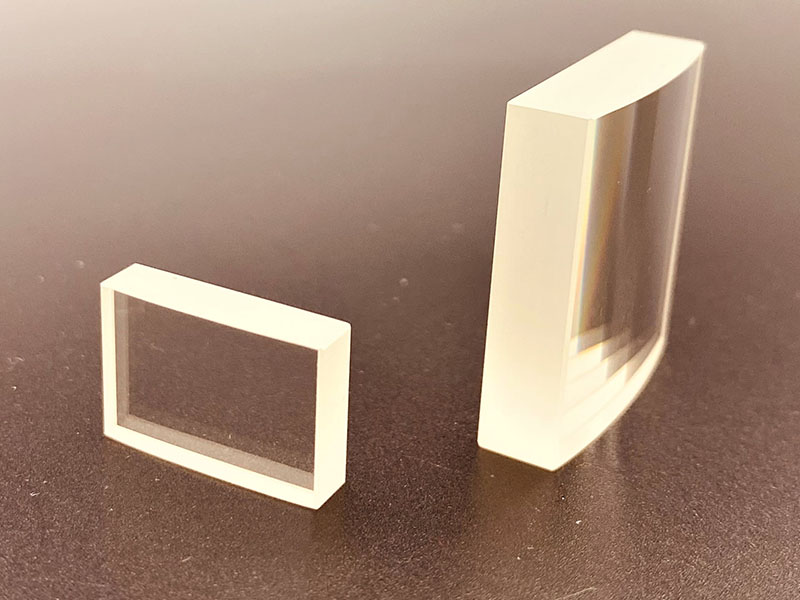
CaF₂ (Calcium Fluoride) Single Crystal
Description
CaF₂ offers 0.13–10 µm transmission and exceptional deep-UV clarity, the standard for ArF (193 nm) and F₂ (157 nm) lithography optics.
Request Information
Technical details
Advantages
- Optical transmission range: 0.13-10 μm.
- Excellent DUV performance: Internal transmittance >99.8%/cm at 193 nm; >90% at 157 nm, making it the material of choice for 193 nm lithography optics .
- Low refractive index and dispersion: n = 1.39908 at 5 μm; low chromatic aberration enables achromatic lens designs without complex correction .
- High laser damage threshold: Suitable for high-fluence excimer laser systems (ArF 193 nm, KrF 248 nm) .
- Low stress birefringence: Typically ≤5 nm/cm (P-V), with advanced grades ≤2 nm/cm.
- Non-hygroscopic and chemically stable: Resistant to climatic exposure and weakly acidic environments.
- Cubic structure: Optically isotropic (no intrinsic birefringence), available in large diameters up to 350 mm.
Typical Specifications
- Crystal structure: Cubic, fluorite type, space group Fm3m; cleavage plane (111)
- Lattice constant: 5.462 Å
- Transmission range: 0.13–10 μm
- Internal transmission: >99.8%/cm @ 193 nm; >99.9%/cm @ 248 nm
- Refractive index: n = 1.39908 @ 5 μm; n = 1.433864 @ 587.6 nm
- Refractive index homogeneity: ≤2 to ≤5 ppm (P-V) for premium grades
- Stress birefringence: ≤2 to ≤5 nm/cm (P-V)
- Density: 3.18 g/cm³ at 25°C
- Melting point: 1360–1420°C (sources vary)
- Thermal conductivity: 9.71 W/(m·K) at 25°C
- Thermal expansion coefficient: 18.85 × 10⁻⁶/K
- Knoop hardness: 158.3 (100) with 500 g indenter
- Young‘s modulus: 75.8 GPa
- Poisson’s ratio: 0.26
- Solubility in water: 0.0017 g/100 g H₂O at 20°C
- Dielectric constant: 6.76 at 1 MHz
Main Applications
- Deep UV lithography optics: Lenses and windows for 193 nm (ArF) and 157 nm (F₂) excimer laser lithography systems. CaF₂ is one of only two materials suitable for 193 nm immersion lithography (along with fused silica).
- Excimer laser windows: High-fluence windows for ArF (193 nm), KrF (248 nm), and XeCl (308 nm) lasers .
- IR spectroscopy and thermal imaging: Windows, prisms, and lenses for FTIR spectroscopy and thermal imaging systems (0.13–10 μm).
- Achromatic lenses and optical systems: Wide-band transmittance and low dispersion enable achromatic lens designs for telescopes, cameras, and imaging systems .