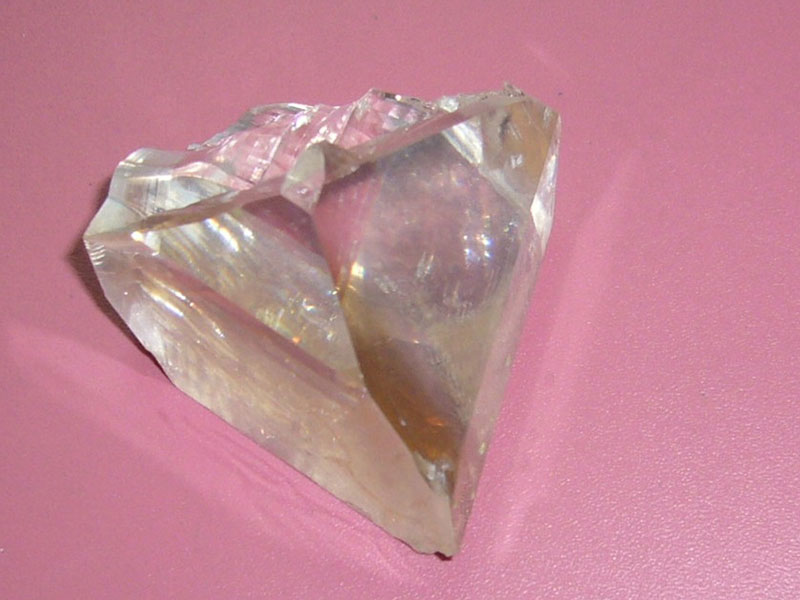
BiBO (BiB₃O₆, Bismuth Triborate) Single Crystal
Description
BiBO (BiB₃O₆) offers an effective nonlinearity 3.5–4× that of LBO, excelling at SHG of ~950 nm radiation to generate blue laser light.
Request Information
Technical details
Advantages
- Exceptionally high effective nonlinear coefficient proximately 3.5-4 times that of LBO and 1.5–2 times that of BBO, enabling efficient frequency conversion in significantly shorter crystal lengths . The effective nonlinear coefficient for SHG (1064 nm → 532 nm) is reported as 3.0–3.34 pm/V .
- Broad transparency range: 286–2500 nm.
- Non-hygroscopic and chemically stable: Insensitive to moisture, with no degradation of conversion efficiency over time under the influence of radioactive radiation .
- Wide temperature bandwidth: Approximately 50% wider than that of LBO under comparable SHG conditions .
Typical Specifications
- Crystal structure: Monoclinic, point group 2 (biaxial)
- Lattice parameters: a = 7.116 Å, b = 4.993 Å, c = 6.508 Å, β = 105.62°
- Transmission range: 286–2500 nm
- SHG phase-matching range: 574-2480 nm
- Nonlinear coefficients: d₁₁ = 2.53 pm/V, d₁₂ = d₁₄ = 2.3 pm/V, d₁₃ = −1.3 pm/V, d₂₅ = d₃₆ = 2.4 pm/V, d₂₆ = 2.8 pm/V, d₃₅ = −0.9 pm/V
- Effective nonlinear coefficient (1064/532 nm): deff = 3.0 ± 0.1 pm/V
- Absorption coefficient: <0.1%/cm @ 1064 nm
- Damage threshold: ~0.3 GW/cm² @ 1064 nm, 10 ns
- Angular acceptance: 2.32 mrad·cm
- Walk-off angle: 25.6 mrad
- Temperature acceptance: 2.17°C·cm
- Mohs hardness: 5–5.5
- Density: 5.033 g/cm³
- Melting point: 726°C (congruent)
- Thermal expansion coefficients: αₐ = 4.8 × 10⁻⁵/K, α_b = 4.4 × 10⁻⁶/K, α_c = −2.69 × 10⁻⁵/K
- Sellmeier equations (λ in μm) :
- n₁² = 3.6545 + 0.0511/(λ² − 0.0371) − 0.0226λ²
- n₂² = 3.0740 + 0.0323/(λ² − 0.0316) − 0.01337λ²
- n₃² = 3.1685 + 0.0373/(λ² − 0.0346) − 0.01750λ²
Main Applications
- BiBO is particularly suited for SHG of ~950 nm radiation to generate blue laser light . Recent demonstrations include 32 W at 515 nm from a 57 W picosecond Yb:YAG thin-disk laser with 56% conversion efficiency using a 1.5 mm BiBO crystal .
- Compact high-efficiency frequency conversion: The high nonlinear coefficient enables efficient SHG in short crystals (e.g., 1.5 mm), reducing group velocity dispersion and temporal walk-off effects relevant in picosecond and femtosecond regimes .
- Spontaneous parametric down-conversion (SPDC): BiBO crystals are used for generating entangled photon pairs via Type-I and Type-II SPDC, with paired-crystal configurations achieving 3° half-angle between signal and idler .
- Optical parametric amplification (OPA): BiBO enables octave-spanning, CEP-stabilized pulse amplification in the mid-IR, with potential for sub-two-cycle pulses exceeding 20 mJ .
- Femtosecond and picosecond laser systems: Suitable for ultrafast applications where short interaction lengths and broad bandwidth are advantageous .