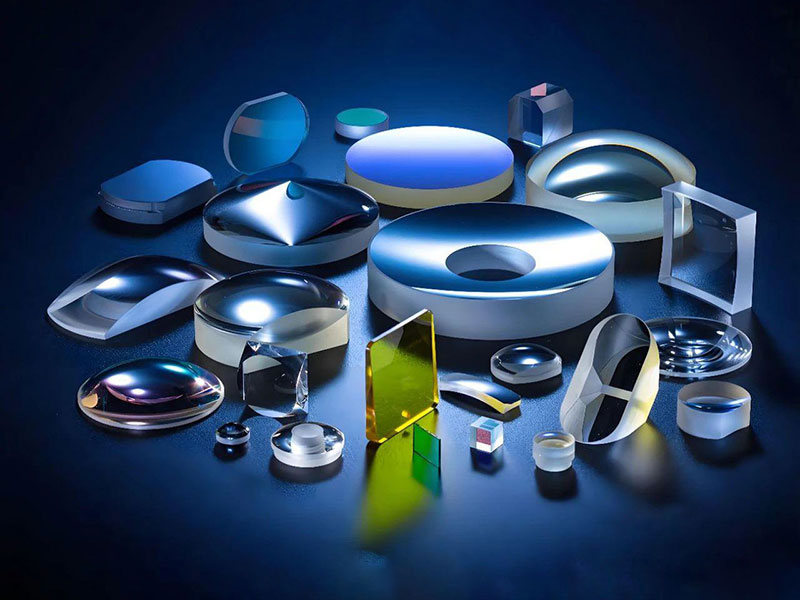
BaF₂ (Barium Fluoride) Single Crystal
Description
BaF₂ transmits 0.15–12 µm with excellent 8–14 µm performance, ideal for thermal imaging windows, IR lenses and long-wave prisms.
Request Information
Technical details
Advantages:
- Broad optical transmission range: 0.15–12 μm.
- Excellent scintillation properties: fast scintillation component peaked at 195 and 220 nm with sub-nanosecond decay time, suitable for ultrafast timing applications.
- Radiation-hard material: high resistance to γ-rays, protons, and neutrons compared with many other scintillators.
- Non-hygroscopic, chemically stable, and mechanically robust under normal handling conditions.
- Cubic crystal structure (CaF₂-type, Fm3m) with good optical homogeneity.
Typical Specifications:
- Crystal structure: Cubic (CaF₂-type), space group Fm3m
- Transmission range: 0.15–12 μm
- Refractive index: n = 1.45 @ 5 μm (approx.)
- Melting point: 1386°C
- Density: 4.89 g/cm³
- Knoop hardness: ~82 (with 500 g indenter)
- Thermal expansion coefficient: 18.1 × 10⁻⁶/°C @ 273 K
- Thermal conductivity: 11.72 W/(m·K) @ 286 K
- Absorption coefficient: 3.2 × 10⁻⁴ cm⁻¹ @ 6 μm
- Fast scintillation decay time: sub-nanosecond (component peaked at 195–220 nm)
- Slow scintillation component: peaked at ~310 nm with decay time of ~600 ns
- Young’s modulus: 53.07 GPa
- Poisson’s ratio: 0.343
Main Applications:
- Thermal imaging and IR optics: Windows, lenses, and prisms for the 8–14 μm passive IR band.
- VUV/UV optics: Components for 157 nm lithography and excimer laser systems (e.g., 157 nm, 193 nm, 248 nm).
- Scintillation detectors: Fast-timing radiation detectors for high-energy physics (HEP) experiments, TOF-PET, and gigahertz hard X-ray imaging.
- Spectroscopic instruments: Windows, prisms, and optical elements for UV/VIS/IR spectroscopy.
- Laser systems: Laser windows and optics for excimer and other laser sources.
- Space-borne and astronomical instrumentation: Optical components for telescopes and spectrographs.