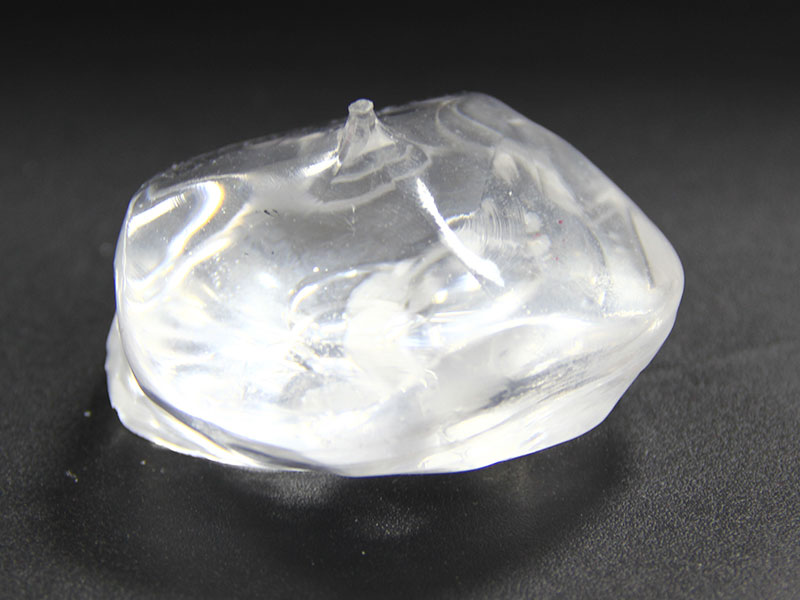
α-BBO (α-BaB₂O₄) Single Crystal
Description
α-BBO transmits from 189 nm to 3500 nm with high UV throughput, the preferred choice for Glan-Taylor and Glan-Thompson UV polarizers.
Request Information
Technical details
Advantages
- Transmission range of 189–3500 nm, with high transmittance (>80%) from 200 to 2200 nm and a UV absorption edge at 189 nm.
- Large birefringence: Δn = 0.116 @ 1064 nm, significantly larger than calcite (0.172) in the UV region while offering superior UV transparency.
- High damage threshold: ~1.2 GW/cm² (1064 nm); >500 MW/cm² (355 nm), making it ideal for high-power UV laser systems.
- Centrosymmetric structure: Non-hygroscopic, chemically stable, with excellent optical homogeneity (Δn ≈ 10 ppm).
- No nonlinear optical properties: Due to its centrosymmetric crystal structure, α-BBO is exclusively used for linear optical applications, not for SHG or other NLO processes.
Typical Specifications
- Chemical formula: α-BaB₂O₄ (high-temperature phase)
- Crystal structure: Trigonal, space group R3c; negative uniaxial
- Transparency range: 189–3500 nm
- Refractive indices (@ 1.0642 μm): nₒ = 1.6579, nₑ = 1.5379
- Birefringence: Δn = −0.1199 @ 1064 nm; −0.1241 @ 532 nm; −0.1503 @ 266 nm
- Walk-off angle (45°): −4.287° @ 1064 nm; −5.082° @ 266 nm
- Density: 3.85 g/cm³
- Mohs hardness: 4.5
- Thermal expansion coefficients: αₐ = 4 × 10⁻⁶/K, αc = 36 × 10⁻⁶/K (25–900°C)
- Thermo-optic coefficients: dnₒ/dT = −16.6 × 10⁻⁶/°C; dnₑ/dT = −9.3 × 10⁻⁶/°C
- Linear absorption coefficient: α < 0.005 cm⁻¹ (300–2300 nm)
- Damage threshold: >1 GW/cm² @ 1064 nm; 500 MW/cm² @ 355 nm
- Hygroscopic susceptibility: Low
Sellmeier equations (λ in μm):
nₒ² = 2.7471 + 0.01878/(λ² − 0.01822) − 0.01354λ²
nₑ² = 2.37153 + 0.01224/(λ² − 0.01667) − 0.01516λ²
Main Applications
- UV polarizers: Glan-Taylor and Glan-Thompson polarizers, especially for high-power and deep-UV applications.
- Polarizing beam displacers: Walk-off beam splitters and polarization beam splitters for UV and high-power laser systems.
- Phase retarders and waveplates: Birefringent plates and time-delay compensators utilizing its large birefringence.
- UV pulse stacking systems: For energy jitter reduction and pulse shaping in UV laser systems (e.g., 266.7 nm), leveraging its large birefringence (0.856 ps retardation per 1 mm thickness).
- Deep-UV laser systems: High-extinction-ratio polarizers and optical components for excimer and deep-UV lasers.